


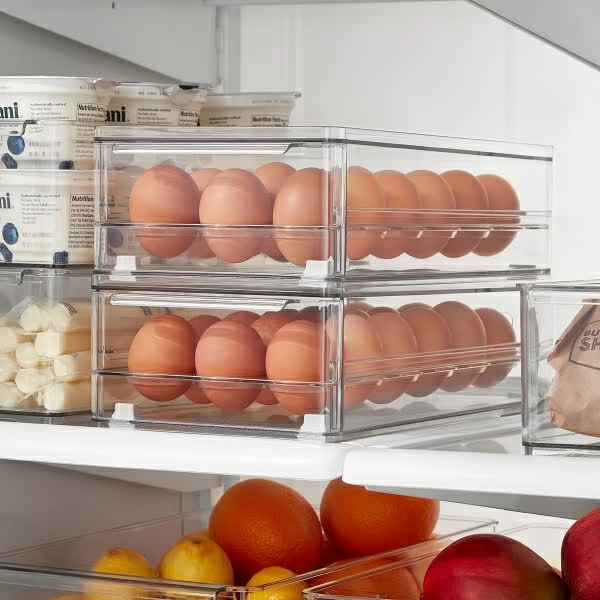
Eggs are a familiar food in every household, can be used in many dishes, and are often purchased in relatively large quantities for later use. However, if not stored properly, eggs can easily lose their freshness, absorb odors, or spoil before their expiration date.
Refrigeration is the most common and convenient option, but in the absence of a refrigerator, some folk methods such as using cooking oil, beans, rice husks, or rice bran are also often applied. Depending on the type of eggs, storage conditions, and intended use time, a suitable method can be chosen.
Store eggs in the refrigerator.
Storing eggs in the refrigerator is the simplest and most common method. For eggs that haven't been processed industrially, they shouldn't be washed with water before storage because this can remove the natural protective membrane on the shell, thereby creating conditions for bacteria to penetrate.
Eggs should be placed in a separate tray or container in an area with a relatively stable temperature, rather than in the refrigerator door, where the temperature frequently fluctuates due to opening and closing. When arranging eggs, you can place the larger end facing up and the smaller end facing down to help keep the yolk in a more stable position.
Eggs should not be frequently taken out of the refrigerator for extended periods and then put back in, as temperature changes can cause condensation to form on the shells. The actual storage time depends on the freshness, handling, and storage conditions of each type of egg.
Preserve eggs using aluminum foil.
Some families use aluminum foil to wrap each egg individually to minimize exposure to air and the elements. After inspecting the eggs, gently wipe the shells with a dry cloth if necessary, then wrap each egg in aluminum foil and place them in a clean box or container.
The eggs should then be stored in a cool, dry place away from direct sunlight. This method is only suitable for stable storage conditions and should not be considered a substitute for refrigeration when eggs need to be kept for extended periods.
Preserve eggs using cooking oil.
Vegetable oil can be used to coat the surface of eggshells with a very thin layer, thereby creating an additional barrier against the external environment. A small amount of sesame oil, soybean oil, or other suitable vegetable oil can be used and then applied evenly to the entire eggshell.
After being coated in oil, eggs should be stored in a cool, dry place away from direct sunlight. However, the shelf life depends on the freshness of the eggs and the actual conditions, so it's still necessary to check them before use.
Preserving eggs using lime water.
Lime water was once used in some traditional egg preservation methods. In this method, the eggs were inspected, cleaned of dirt from the shells, and then placed in clean jars or containers before the lime water was added.
Eggs should be stored in a cool, well-ventilated place, away from direct sunlight, and checked regularly during storage. With this method, special attention must be paid to the cleanliness of the equipment, the initial quality of the eggs, and the hygienic conditions to avoid compromising food safety.
Preserving eggs with salt
Salt is also used in some traditional egg preservation methods. A layer of dry salt can be spread on the bottom of a container, the eggs placed on top, and then more salt is added to ensure the eggs are relatively tightly enclosed.
Layers of salt and eggs can be stacked alternately until the container is full, then sealed and stored in a cool, dry place. Eggs should be checked regularly, and any showing signs of cracking, leaking, or abnormality should be discarded immediately.
Preserving eggs using beans
Certain types of dried beans, such as mung beans, black beans, red beans, or soybeans, can be used as a coating material around eggs in traditional preservation methods. The eggs are layered alternately with each layer of beans so that the surface of the eggs is relatively completely covered.
After packing, the egg cartons or containers should be placed in a cool, dry place away from heat sources. This method is more suitable for short-term storage and requires regular inspection of the eggs for signs of spoilage.
Preserve eggs using rice husks or sawdust.
Dry rice husks or clean sawdust can be used to wrap around eggs, helping to reduce impact and create a drier environment during storage. First, line the bottom of the container with a layer of rice husks or sawdust, then arrange the eggs on top and cover with another layer of this material.
Layers of eggs and rice husks or sawdust are arranged alternately until the container is full. After sealing, the container should be placed in a dry, cool place and checked regularly to promptly remove any eggs showing signs of spoilage.
Preserving eggs with rice bran.
Dry rice bran is also used in some traditional egg preservation methods. A layer of bran can be spread on the bottom of a clean container or jar, eggs can be placed on top, and then more bran can be applied until the eggs are completely covered.
During storage, eggs should be checked periodically for cracks or other abnormalities. If spoiled eggs are found, they should be quickly separated from the rest to minimize impact on overall quality.
Preserving eggs using used tea leaves.
The used tea leaves can be dried thoroughly in the sun or oven and then used to coat the eggs. The eggs are arranged alternately with layers of tea leaves so that the surface of each egg is relatively completely covered.
The container or box should be placed in a dry, cool place and away from direct sunlight. The tea leaves must be completely dry before use, as any remaining moisture can create conditions for mold growth.
Things to remember when storing eggsOne important principle when storing eggs is that you shouldn't wash unprocessed eggs before storing them. The natural membrane on the shell helps limit the penetration of microorganisms, so if the eggs aren't too dirty, simply wipe them gently with a dry cloth or clean them right before cooking. If storing eggs in the refrigerator, avoid placing them in the door area as this is subject to frequent temperature fluctuations. Eggs should also be kept away from strong-smelling foods like onions, garlic, or fish to minimize odor transfer. When storing eggs outside the refrigerator, choose a cool, dry place and avoid direct sunlight or heat sources. High temperatures and high humidity can both cause eggs to deteriorate more quickly. In addition, eggshells should be inspected before storage, and any cracked, leaking, or abnormally shaped eggs should be discarded. Before cooking, if eggs have a strange odor, or if the egg whites or yolks have an unusual color, they should not be used. Depending on storage conditions and intended use time, each family can choose the most suitable method. Among these, refrigeration remains the most convenient and easiest to control option, while traditional methods require clean, dry conditions and regular egg inspection to minimize the risk of spoilage. |