



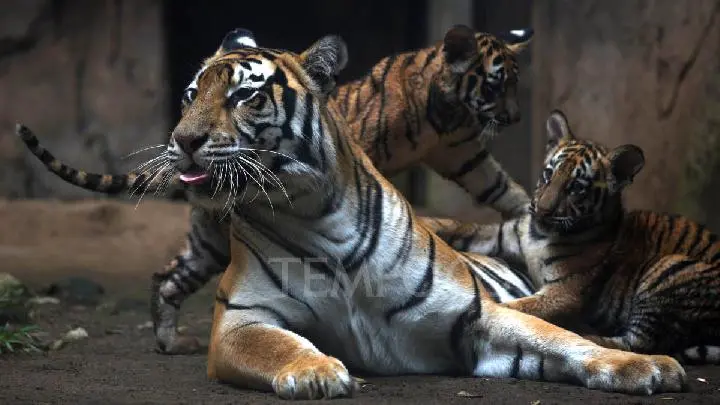
TEMPO.CO, Jakarta - A second Bengal tiger cub died at Bandung Zoo on Thursday morning, a couple days after its 8-month-old twin cub died earlier on March 24.
"The medical team determines the cause of death as virus," Eri Mildranaya, the Public Relations of the West Java Natural Resources Conservation Agency (BBKSDA), told Tempo on Thursday, March 26, referring to feline panleukopenia virus (FPV).
Quoting the veterinarian team, Eri said the virus that attacked the pair of Bengal tiger cubs, born on July 12, 2025, could originate from their mother. "The history of how they got infected is unknown," said Eri.
The virus has a long incubation period, and signs of infection were detected on the tiger cubs on March 22, 2026. "The critical period was 48 hours," Eri said.
Not only can FPV be transmitted to tiger cubs, but it can also be transmitted to adult feline animals. Nevertheless, Eri said no plans are made to relocate big cats at Bandung Zoo to other locations to prevent transmission. "Prevention is done by bolstering biosecurity," he said.
The two Bengal tiger cubs died while the Bandung Zoo was operated by the Bandung City government after the country's Ministry of Forestry revoked the permit of zoo management, the Margasatwa Tamansari Foundation, on February 3, 2026.
Bandung Mayor Muhammad Farhan said the experts' exam showed that the two tiger cubs were infected with a virus that rapidly developed over the past week and was acute. "This is highly concerning and serves as an important lesson for all of us," he said in a written statement on Thursday.
Farhan emphasized that immediate action is now focused on strengthening the biosecurity system in the zoo area. He invited the West Java Provincial Government and the central government, including the Ministry of Forestry, to conduct a comprehensive evaluation of the zoo's management.
The Bandung City Government aims to complete the management improvement within one month and will appoint a legally established conservation institution as an official partner in Bandung Zoo management. Farhan said the zoo shall continue its primary function as a conservation body for rare wildlife.
Read: Two Sumatran Tiger Cubs Born in Barumun Sanctuary, Symbolize Hope for Conservation