



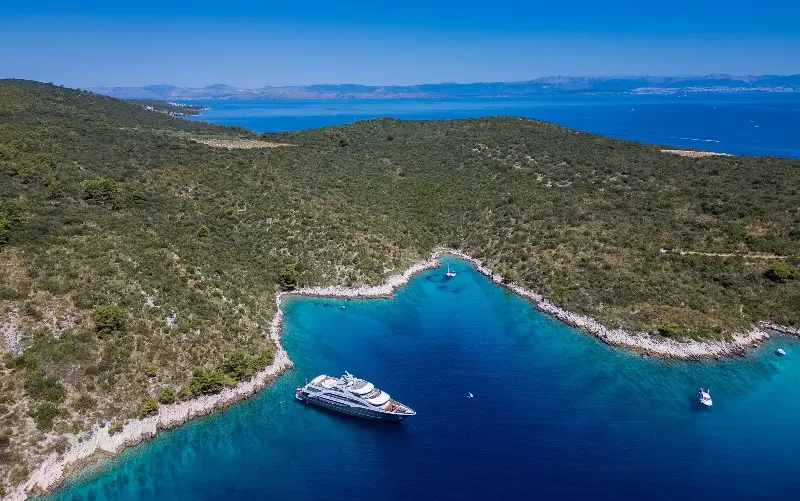
As MV Aretis eases away from Dubrovnik, fellow passengers and I gather on deck to raise a glass to the week ahead, the city’s towering stone walls – built to defend the “Pearl of the Adriatic” – rising behind us.
Croatia’s greatest asset, however, lies beyond Dubrovnik and Split, the country’s second city, in the maze of islands scattered between them, which reveal a different rhythm: fishermen hauling oysters from sheltered bays, family wineries carved into limestone hillsides and pine-fringed coves accessible only by boat.
This is the start of a week-long sailing around some of Croatia’s southern islands: Mljet, Korčula, Hvar, Vis and Trogir. It’s a route that lets us slip past the crowds and into the quieter corners – where the real magic of the Adriatic reveals itself.
A sociable sailing
The 36-passenger Aretis has sleek superyacht lines that are a constant topic of conversation among guests – a convivial mix of Australians and Americans, mostly in their 50s, although every age group is represented, right down to a couple from California celebrating the wife’s 80th birthday with their extended family.
After just one day, I know them all by name. This is cruising on a personal scale, aboard a vessel that feels a world away from the behemoths dominating many Mediterranean itineraries. It’s an intimate affair with staff – all Croatian nationals – who soon learn our preferences: how I like my eggs at breakfast, the wine I order with lunch, the cocktail I sip at sunset.
When we do spot one of the mega-ships, it’s met with good-natured disdain by my fellow passengers, who congratulate themselves on their intimate sun deck, inviting Jacuzzi, covered lounge area, and daily swim stops that no floating city could ever manage.
These swim stops quickly become the highlight of each day. Every morning, our captain drops anchor, and we jump off the back of MV Aretis into clear turquoise waters to float on foam noodles and inflatable rings while laughing and chatting happily with each other.
There’s a lot of socialising among guests – the MV Aretis is not a ship for shrinking violets, and anyone after solitude should look elsewhere – much of it over lavish three-course lunches utilising ingredients sourced from local markets. Standout dishes include Adriatic sea bream in škartocu (parchment paper) and pistachio cheesecake. All are served at open tables of seven or eight that encourage a level of mingling I’ve rarely experienced on larger vessels.
Island life at a slower pace
Both breakfast and lunch are included in the fare, as are excursions, which are built around authentic, locally rooted experiences: an oyster tasting at Mali Ston, where flat, briny local oysters are pulled straight from the bay and shucked to order, a world away from the farmed variety most of us know.
On Mljet, a long, forested island that feels wonderfully removed from Croatia’s busier coastal hotspots, we hire bikes to circle Veliko Jezero and Malo Jezero, the island’s two saltwater lakes, with just the pines stirring in the wind and birdsong for company. Later, we swim from the rocky shore in water as warm as a bath.
We sail on to Korčula – our cruise director’s favourite port, and perhaps mine too owing to its wonderfully inventive architecture. The streets of the walled old town fan out in a herringbone pattern, designed to let cooling air circulate in summer while shielding residents from the fierce winter bura winds.
Korčula also claims to be the birthplace of Marco Polo – Venetians hotly dispute this – and our guide walks us through the tangle of streets, recounting the explorer’s life with such conviction that, for an hour at least, we’re all believers.
Croatia’s wild child
Next it’s on to tiny Vis, the most isolated Croatian island and one with an extraordinary backstory: it was a secretive Yugoslav naval base, closed to outsiders until the fall of communism in the early 1990s. All of which explains why Vis still feels wilder and less polished than its neighbours despite receiving a surge of visitors following its starring role in the 2018 film Mamma Mia! Here We Go Again.
Here, the highlight for me is the Blue Cave, accessible only by small boat (€25/£22pp). Even early in the morning, motorboats are queuing to duck through the dark tunnel beneath the limestone. Our boatman jokes he has crossed it blindfolded so many times he could do it again. He then covers his eyes for effect as he steers us through the narrow black passage.
We emerge into a chamber where the water glows electric blue as sunlight ricochets off the seabed. Shoals of fish drift beneath us as we sit in silence, transfixed.
Beyond the superyachts
On the glamorous island of Hvar, it’s easy to see why visitors flock here. Superyachts bob in the harbour, café terraces spill into the sunshine, and the honey-stone streets of Hvar Town hum long into the evening.
Yet the island has more to offer than its waterfront. We head inland to Tomić winery, where generations of the same family have been making wine for more than 150 years. In a cellar carved into the bedrock, our group bonds further while sampling robust reds and crisp whites and learning how Hvar’s rocky terrain and abundant sunshine shape every bottle.
Later, I dine at Black Pepper, a restaurant recommended and reserved for us by Unforgettable Croatia. Since our cruise is half-board, we’re in port most evenings, free to explore the islands’ local restaurant and bar scenes for ourselves rather than retreating to a dining room onboard.
Trogir, the historical island town near Split, has a timeless feel. During a walking tour of the old town, our guide stops beneath the Kamerlengo Fortress and tells us how locals once used its walls as a lookout for pirate ships – a tradition of watching the harbour that, he jokes, hasn’t entirely died out.
There’s time to stroll independently through the old town’s warren of Venetian-era alleyways, before returning to Aretis for the “captain’s dinner” – one of only two evening meals served onboard. The crew lay on a feast, and later we all dance out on deck to pop classics with wild abandon – the Californian couple celebrating the wife’s 80th leading the way – into the small hours.
Curious passers-by stop and wave and try, half-seriously, to talk their way aboard to join us, confirming what we already know: ours is the ship to be on.
One last look
On the final morning I wander the streets of Split’s old town, wrapped around Diocletian’s Palace, the extraordinary Roman ruin from which the whole city grew. I amble down to the Riva, Split’s palm-lined seafront promenade, and spy our ship, MV Aretis – glittering on the Adriatic, exactly as it has all week.
Seven days on, I know exactly how cruising in Croatia should be: small, unhurried and immersive. Morning swims in water clear enough to see straight to the seabed, evenings spent exploring rather than sailing away at sunset.
A week ago, we stood on deck in Dubrovnik raising glasses to the adventure ahead. Now, on the quayside in Split, the same passengers who boarded as strangers are exchanging hugs and Instagram handles.
I came for the islands. I’m leaving with 35 new friends, a deeper understanding of Croatia and a firm conviction that, for me, small is the only way to sail.
How to do it
Unforgettable Croatia offers seven-night, small-ship cruises between Dubrovnik and Split aboard MV Aretis from £1,842pp. The price includes breakfast, lunch, two dinners, private transfers, excursions and Wi-Fi. Excludes flights.