



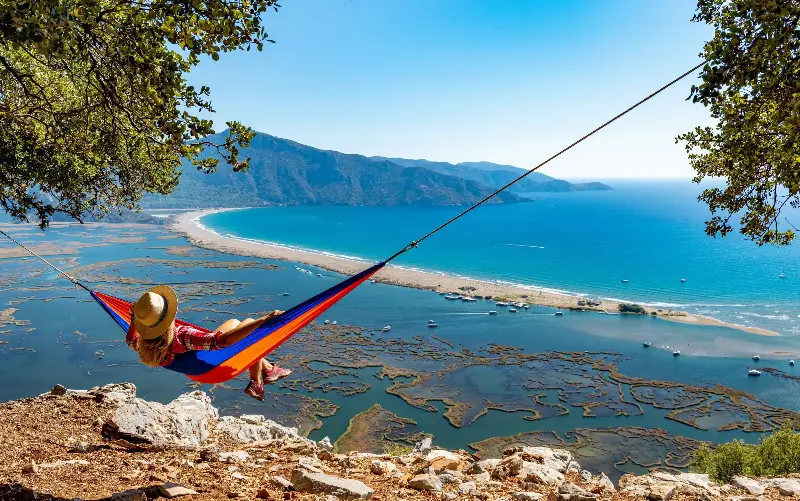
Social media can make any beach look like paradise – only for reality to wash it away. One quick way to spot the real deal is to check whether it has Blue Flag status: an internationally recognised award given to beaches that meet 33-plus strict criteria covering water quality, safety, access, and environmental management. Crucially, it isn’t permanent. Beaches must earn it back every season.
What is a Blue Flag beach?
So, what exactly sets these beaches apart? Yes, bathing water quality is central – requiring regular testing, strict thresholds, transparency of results – but the criteria go far beyond clean water. A Blue Flag beach must also deliver on safety, services and environmental stewardship. That means lifeguards on duty, first-aid equipment available, clearly marked zones for swimmers versus boats, regular cleaning of the sand, well-maintained toilets, access to drinking water, and facilities for people with disabilities.
There’s an educational element too. Beaches must have information boards explaining local ecosystems, codes of conduct, and sometimes organised activities. In other words, it’s as much about how a beach is run as what’s in the water. A pristine cove with no facilities won’t qualify; nor will a well-equipped beach with poor water quality. The whole point is balance.
A potted history
The idea began in 1985 in France, when the Foundation for Environmental Education (FEE) set out to show how litter travels far beyond local beaches. A thousand students signed letters naming their nearest beach, sealed them in bottles, and cast them into the Atlantic, letting the currents carry their message across borders to draw attention to the state of the seas.
It worked. Two years later, in 1987 – the European Year of the Environment – the scheme expanded across the continent. And the symbol they chose – a blue flag with a white circle and three waves – soon flew over beaches, marinas, and inland bathing sites in ten countries.
A grassroots nudge had turned beach cleanliness from a local gripe into a public cause and, by 2001, it had spread as far as South Africa, marking its transition into a global programme.
The UK and Ireland joined in the late 1980s. Most designated beaches were in England and Wales in England and Wales, including Botany Bay, West Wittering Beach, Cromer, Whitley Bay and Sandbanks. Today, the UK has just under a hundred Blue Flag beaches. Respectable, but still far behind the leading countries.
Why doesn’t the UK have more of them?
Part of the reason is cost. Blue Flag status is voluntary and maintaining it requires continuous investment. And for councils under pressure, the decision to pursue or retain the award isn’t always straightforward. Lose it, and it makes headlines; gain it, and it becomes a powerful, wordless signal to visitors. And that’s its main strength: visibility. A flag flying on the sand that condenses a long checklist of standards into something instantly recognisable. But that simplicity is also its weakness. Critics argue the flag can flatten complexity, masking local challenges or trade-offs. And in some places, that tension is starting to show.
In Torbay, Devon – home to six Blue Flag beaches including Breakwater, Broadsands and Torre Abbey Sands – the council recently voted to walk away from the scheme altogether. In its place, it plans to introduce a new system, the English Riviera Bathing Standards, with flags due to appear by summer 2026. Local officials argued that some Blue Flag requirements – such as zoning water areas with buoys – don’t suit smaller, more irregular coves.
The move has divided opinion. After all, the Blue Flag has become a global shorthand for quality, now flown at more than 5,000 beaches in more than 50 countries and the flag’s appeal is its consistency. Its challenge is whether that consistency can stretch to fit every coastline.
Which countries have the most – and where are the best ones?
Spain: 642 Blue Flag beaches
Year after year, Spain dominates the Blue Flag leaderboard. Its vast coastline and tourism-driven economy make beach quality a national priority. Favourites include the elegant crescent of Playa de la Concha in San Sebastián, where city life meets golden sand; the Caribbean-like shallows of Ses Illetes Beach in Formentera; and Playa de Muro in Mallorca, a broad sweep of soft sand ideal for unhurried family days.
Greece: 623 Blue Flag beaches
Close behind, Greece has made the programme almost ubiquitous due to its deep reliance on summer tourism. On its islands especially, Blue Flags act as a quiet guarantee of quality in a fiercely competitive market. Top picks include the pink-hued sands and shallow lagoons of Elafonisi Beach in Crete; Myrtos Beach on Kefalonia, a dramatic arc of white pebbles framed by towering cliffs and electric-blue sea; but the northern region of Halkidiki on Crete holds the highest concentration.
Turkey: 577 Blue Flag beaches
Coming in third: the Turkish Riviera. İztuzu Beach, near Dalyan, was Turkey’s first beach to be awarded Blue Flag status and the long, golden barrier is a loggerhead turtle nesting site. The blue lagoon of Ölüdeniz Beach, where paragliders drift from the mountains above, is also striking – as is Kaputaş Beach in Kaş, tucked between steep cliffs, where a ribbon of sand meets startlingly blue water.
Italy: 487 Blue Flag beaches
Italy may not match Spain’s scale, but it was another early adopter of the Blue Flag scheme. Spiaggia dei Conigli on Lampedusa is a vital nesting site for loggerhead turtles; Cala Mariolu in Sardinia is a pebble beach with crystalline water; and Baia del Silenzio in Liguria is a storybook bay edged by pastel houses.
Portugal: 404 Blue Flag beaches
Portugal consistently punches above its weight, packing a high density of Blue Flag beaches into a relatively small coastline. Investment, strong environmental standards, and the pull of the Algarve have all played their part. The country’s best beaches feel both rugged and refined: Praia da Marinha, where dramatic honey-coloured cliffs arch over pristine Atlantic water; Praia da Falésia, an immense stretch of sand backed by rust-red cliffs that glow at sunset; and Praia de Odeceixe, where a winding river meets the ocean, offering both wild surf and calm, sheltered bathing.