



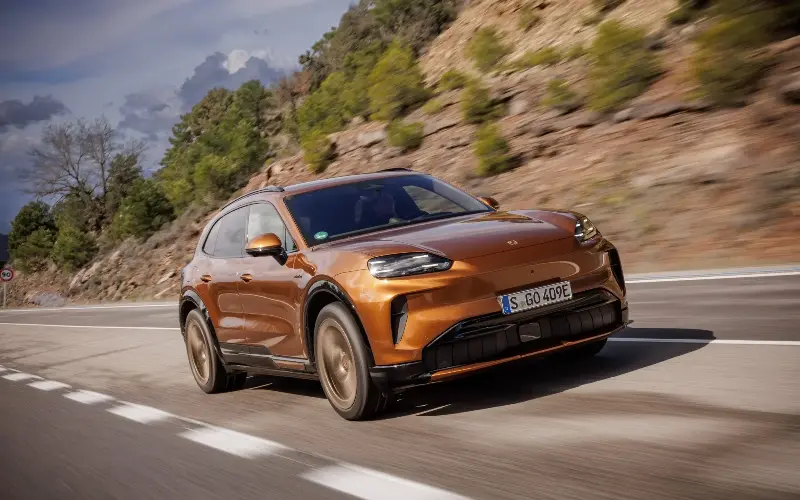
Never far from controversy, the Cayenne was ridiculed as a Chelsea Tractor, an excessive SUV for well-heeled urbanites, at its launch in 2002. Yet it has since sold 1.5 million through three generations, saving Porsche.
This fourth-generation is electric, although not everything running on batteries has been an unalloyed success for Porsche since the Taycan of 2019 or the Macan of 2024, with reports of dubious reliability and poor residual values.
The company has subsequently become more realistic about electric vehicles (EVs) in its marketing mix, so the third-generation petrol and hybrid Cayenne will continue rather than be replaced entirely by this all-electric model.
On performance, the Cayenne Electric leads the range on performance. But forget the standard £83,200, 436bhp, 399-mile-range Cayenne. What you need is the 383-mile-range Turbo (no turbocharger in it, of course, which is now a marketing name) at £130,990 (plus a few extras). That buys you 1,140bhp with the launch control system’s 10 sec boost engaged, 1,106lb ft of torque and four-wheel drive.
Add optional four-wheel steering (£1,389), air suspension (standard) with active individual damping (a £6,799 option) and you have a 2.6-ton SUV capable of 183mph and 0-62mph in 2.5sec. In fact, the Turbo’s bespoke rear motor pack develops more power than the 2002 Cayenne Turbo’s 4.5-litre, twin-turbo V8 petrol engine.
How to make yourself sick
Have you ever accelerated from 0-62mph in 2.5sec in a car that doesn’t squat or pitch, with powerful electric-drive motors which produce most of their pulling power at zero revs and which has so much grip that the tyres don’t spin?
One second you are sitting still, the next you are accelerating at 1.13g. It’s absolutely horrible and pretty hard to avoid fainting or vomiting – or both. As one journalist said: “You’d only ever do that once, wouldn’t you?”
The bits that make all this happen include a 113kWh lithium-ion battery comprising 192 LG pouch cells in 12 packs, each liquid cooled via upper and lower plates. The cathode chemistry is Nickel Manganese Cobalt (NMC), with the nickel content up to 86 per cent, which increases the energy density and reduces the dependence on cobalt. Aluminium in the NMC mix adds strength and longevity to the cathode, which helps avoid long-term damage in low-state-of-charge, fast-charging conditions.
The motors are all permanent-magnet synchronous units, the inverters are the latest silicon-carbide units for faster switching and the operational electronics are 800-volt, which allows faster current flow in and out of the cells.
The braking regeneration capacity of the Turbo model is up to 600kW, one of many innovations on the Cayenne derived from Formula E racing. The Cayenne will fast charge up to 400kW DC and 22kW AC. There’s also a free three-year subscription to the Porsche Charging Service, which reduces the cost of on-the-go charging.
To come is an inductive charging via a garage-floor plate, rumoured to cost about £7,000. All UK cars will be pre-wired for its adoption.
Unlike the Taycan, there’s no separate two-speed transmission, step-down gearing for the front and rear motors. And it’s based on the VW Group Premium Platform Electric 14 which also underpins the Macan and Audi Q6.
Inside job
The interior feels spacious at the front and generous rear space for three across on seats which electrically adjust for rake and reach. Myriad upholstery options cost a fortune, but the dark claret trim of the launch car seemed tasteful and comfortable, while the huge sunroof provides light (and electrically dims if the sun is too bright).
The boot is high off the ground, but spacious, with 506 litres with the rear seats up, 1,588 litres with them (electrically) folded, plus a 90-litre storage area under the bonnet. The load bed is almost flat.
An all-new fascia has a couple of screens and a heavily curved instrument binnacle with graphics showing traditional-looking Porsche dials. The “flow” touchscreen in the centre is essentially a large portrait screen bent in the middle, with the lower part being used for touch tiles and the more vertical upper for the display. It’s better than it sounds and fairly simple to find the most-used functions, while there are buttons to back up the screen including turning off the speed-limit warning and lane-keeping systems.
On the road
It’s no lightweight, but the air suspension and active damping shrink perception a bit even though it never feels anything less than very large and heavy.
On bumpy roads, there’s always a feeling of comprehensive management, of suspension puffing up and down, of dampers being placed over bumps and into undulations. It’s fast and comfortable and long-legged, but you don’t get the communication with the road that you do in, say, a Range Rover Sport.
On 22in wheels, in Comfort mode, it’s too soft, heaving slightly and wobbling its way through corners, but Normal provides a well-balanced blend of ride quality and handling.
There are a couple of sport modes which firm everything, plus an off-road setting and three levels of brake energy recuperation, with a rather unconvincing active regeneration braking setting. Because of its size, on anything less than a sweeping A-road you don’t use even a fraction of the power unless you can see through the corner to the exit – during the entire launch I probably used full throttle no more than a handful of times.
Off-road, the electronic management of the body and suspension is even more impressive, with a substantial level of grip and agility.
It’s mostly down to the electronics controlling the torque distribution, brakes and steep descents. A camera-based “transparent bonnet” system allows you to see where the front wheels are in relation to the track, while a reverse assistant function backs you out of whatever sticky patch you end up in.
The Telegraph verdict
The regular Cayenne is a perfectly acceptable and really quite competent battery-electric SUV. It is brisk, luxurious and, with some well-chosen options, impressive off-road. A worthy opponent to the Range Rover Electric due at some point this year.
The Turbo, however, is bonkers, 125kg heavier, much more powerful and seems to exist only because some wealthy folk appear to think that too much is never enough. Good luck to them but, as a Porsche engineer admitted, “it’s a bit of a beast”. And who wants one of those?
The facts
On test: Porsche Cayenne Electric Turbo
Body style: five-door premium SUV
On sale: now, first deliveries end of June
How much? from £130,900 (standard Cayenne from £83,200)
How fast? 183mph, 0-62mph in 2.5sec
How efficient? from 2.78 miles/kWh, 2.13 miles/kWh on test
Powertrain: 113kWh gross, lithium-ion NMC plus aluminium in 192 cells, twin motors with step-down gearing, four-wheel drive
Range: 383 miles (WLTP), 240 miles on test
Charging: 400kW DC fast charging, 10-80 per cent in 16min on 800-volt charger, 26min at 400v; 9.6kW AC charger 0-100 per cent in 13hrs.
Maximum power/torque: 845bhp (1,140bhp for 10sec with launch control)/1,106lb ft
CO2 emissions: 0g/km (tailpipe), 32g/km (CO2 equivalent well-to-wheel)
Vehicle Excise Duty (VED): £10 first year, £640 next five years, then £200
Warranty: three years/unlimited mileage, eight years/100,000 miles on battery
The rivals
BMW iX M, from £114,305
Almost 660bhp and a 109kWh battery give an efficiency of 3m/kWh to provide a 365-mile range. Lightweight construction doesn’t actually make for a lightweight (it’s 2.6 tons), but it’s fast and comfortable if not that efficient.
Audi Q6 E-Tron Quattro, from £86,440 for launch edition
With a mere 383bhp this is a more sensible option, based on the same platform as the Porsche. Range of 381 miles and a maximum charge rate of 270kW makes this a bit more house-trained than the Cayenne.