



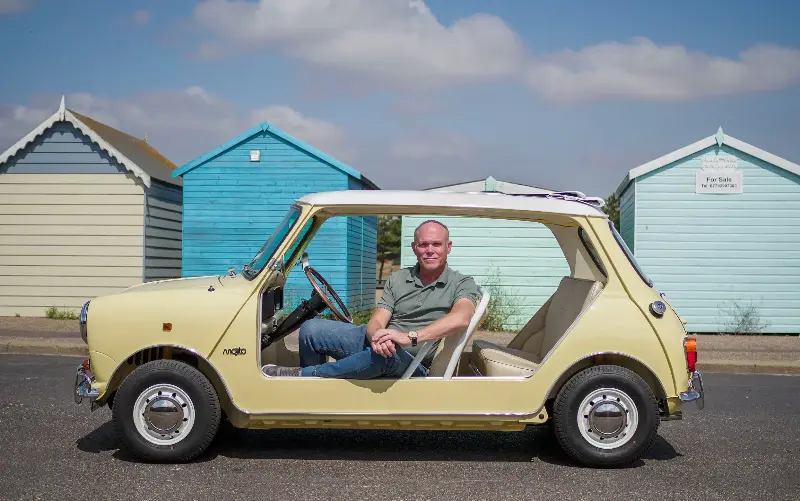
Earlier this year, if you had told me that an open-sided, open-topped original-Mini-based “beach car” was remotely practical for British climes, I would have laughed you out of my rain-spattered front door. But now that we’re all smouldering like it’s 1976 once again, I’m beginning to wonder whether the Crayford Mojito Mk2 you see here might well be as perfect for the English Riviera as it is for the Côte d’Azur.
If you’re of a certain age, you may well recognise the name Crayford – a doyen of converted Cortinas, Capris and Marinas in the 1960s and 1970s. But one of the original company’s successes was its Mini Convertible, of which about 800 were sold, Crayford then charging £150 to slice off the little car’s roof and replace it with one made of fabric. Today’s version approaches the open-air theme in a very different way, but as we’ll discover, one that also manages to retain the original Mini’s kart-like driveability.
Paul Osborn, the brains behind the Mojito, bought the Crayford name in 2023 with a view to developing a beach car that could compete with others in the market, such as Moke International’s fully electric MOKE (£36,200) and Garage Italia’s similarly powered 500 Spiaggina (€85,000/£73,000), based respectively on the original Mini Moke and Ghia-built Fiat 500 Jolly.
The 100 per cent British-based project was an about-turn for Osborn, who had, for the last four decades, been more used to dealing in high-end exotica and ex-Formula 1 cars through his Chequered Flag International business in Los Angeles. Now back in Southend-on-Sea, his newly formed Crayford has so far built five of these Mojito Mk2s (the Mk1 had a different roof arrangement), with the one I’m about to sample being readied for customers to assess on the aforementioned French Riviera – unsurprisingly, a target market, along with California and the Caribbean islands.
Full restoration
They are likely to be impressed. About 1,000 man-hours goes into each Mojito, and starts with Crayford sourcing a solid, pre-2000 “classic” Mini. While the car retains its original VIN (chassis number) and registration – hence why our test car has an R suffix, denoting a 1977 build – everything is rebuilt to an as-new standard.
The shell is stripped, completely restored and has its doors, rear side panels and central pillar removed. The suspension is overhauled, too, with components either refreshed or replaced where necessary. And then begins the real transformation from humble Mini to Mojito: a new, specially designed raised sill section is welded in that partially fills the exposed sides of the car and neatly integrates with the existing windscreen pillar.
The roof panel, meanwhile, receives a full-length, fold-back sunroof (importantly, it is the Mini’s roof, supported by the retained screen and rearmost pillars, from which the body derives its strength, meaning no extra reinforcement is required).
Water-resistant finis
Finally, the seats are re-padded and, along with the dashboard, are trimmed in water-resistant Sunbrella, a material more commonly found in the cockpits of superyachts. The Mojito’s floor is also dressed in Flexiteek, another marine-grade covering that is a more sustainable replacement for traditional teak.
Does that sustainability extend to this diminutive beach car’s engine, though? Well, in a way it does, since Crayford preserves and rebuilds the donor car’s A-series unit, which can be supplied to either 1,000cc or 1,275cc specification (our test car’s is the former, with the unit immaculately presented under the bonnet).
But as Osborn admits: “The first question people ask is when it will be available with an electric powertrain.” And you can see why: with typical customers only requiring a small range and minimal performance, a Mojito EV would make more sense as a coastal conveyance. So it’s just as well that Crayford is already developing such a derivative, with which it will gain single vehicle approval (SVA) to allow it to be sold as a new car.
On the road
For the time being, though, I’m strapped into the Mojito’s comfy driver’s seat with my aircraft-style lap-belt tightened, firing up its four-cylinder combustion engine. You peer through a typically canted-forward steering wheel – wood-rimmed with alloy spokes – at a three-clock binnacle plucked from a Clubman, rather than the large, centrally located clock for which classic Minis are better known. Osborn explains that customers prefer this set-up, which also gives the car a locking steering column and self-cancelling indicators. There are no blind spots here; I can see as much of Southend’s sun-soaked coastline glancing to my left as I would perched on a deckchair – the view out is truly panoramic. A little disconcerting, too.
The A-series engine emits a friendly growl as you work your way through the light and longish-throw four-speed gearbox. It seems strange not having the protection of doors and windows, but any such concerns are soon dismissed: the performance is peppy enough (40bhp in a car weighing about 600kg feels just right for this application) and on a warm and sunny day such as this, it’s a real boon being at one with the elements from almost all angles.
Solid feeling
It’s also a treat to drive a classic which is effectively a new car, with no rattles or squeaks and an underlying feeling of solidity. That also translates to its pin-sharp handling and strong brakes, helped by fitting Mini Cooper discs and 10-inch wheels shod with wider Cooper-spec tyres. But that’s missing the point. The Mojito is a fun car, certainly, but its deeper appeal is in its old-world, open-air simplicity with which no modern contrivance could ever compete.
At an entry price of £35,000 it will remain a rich person’s toy. But, as the Telegraph’s new and used car expert Alex Robbins concludes, beach cars such as the Mojito could be a more common site here in future. “With temperatures in the UK now regularly exceeding those you’d have found in the Med just a few short years ago, it’s no longer quite such a stretch to imagine that warm-weather playthings like the Mojito and Moke might start to pop up in our beach resorts,” he says.
“So when places like Margate feel more like Menton, it isn’t beyond the realms of possibility that they might find willing buyers here in Britain.”