



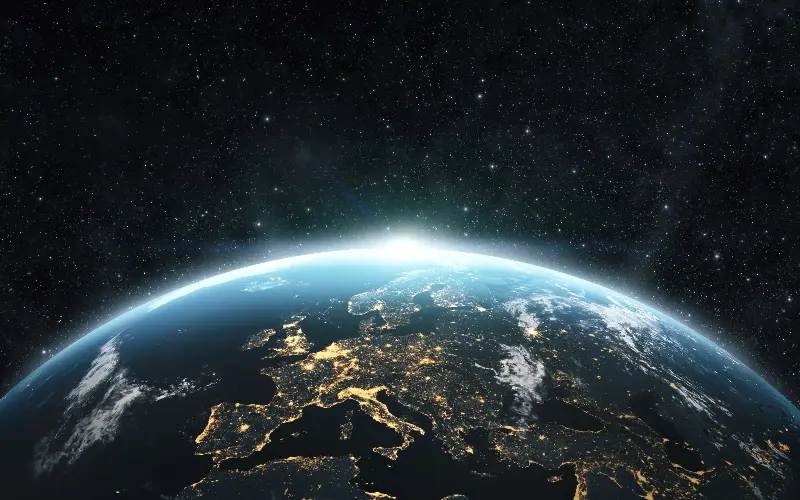
As our resident myth-buster, Sarah Knapton has seen a thing or two. Now, she’s taking on some of the world’s best-known conspiracy theories to see if they hold water. In the first part of this series, she weighs up the idea that the Earth could really be flat…
In 1838, Samuel Rowbotham, an English inventor and flat-Earth proponent, conducted a bizarre experiment on a dead straight six-mile stretch of the Old Bedford River in the Cambridgeshire Fens.
Rowbotham postulated that if the Earth really was round, he should be able to place a flag at one end of the uninterrupted watercourse and be unable to see it through a telescope as it would dip below the horizon.
To his delight, the flag remained visible, supporting his view that the world was indeed flat.
However, he had made a grave miscalculation. In January 1870, Alfred Russel Wallace, a naturalist, returned to the river and showed that the flag had been visible because of atmospheric refraction – a distorting effect that makes objects appear higher.
He carried out his own experiment, placing five posts much higher along the river to avoid refraction, and demonstrated that the middle post was slightly taller than those further downstream, as they fell away with the Earth’s curvature.
It is the same effect that makes ships’ masts visible for much longer after the hull has vanished over the horizon. If the Earth were flat, the ship would shrink uniformly as it headed into the distance.
Wallace’s experiment failed to convince the flat-Earthers, and to this day many still reject the scientific consensus of a spherical planet spinning at more than 1,000mph.
Some adherents believe the world is a disc with the Arctic Circle at the centre surrounded by land masses and with Antarctica at the edges. Others think it is a plain that goes on forever.
They argue that the horizon looks flat even if you climb 29,000ft to the top of Everest or travel in an aeroplane, and claim that water cannot stick to a curved surface, so the seas would simply pour away if they were on a globe.
To explain gravity, some claim that the flat Earth is accelerating upwards constantly, giving the effect of things being drawn backwards towards the surface, in the same way you feel heavier when going up in a lift.
At first glance their arguments appear to hold water, but dig a little deeper and their claims go down the plughole.
For a start, the Earth is vast and the curvature is so slight at that scale that it is imperceptible until you’re looking down from around 35,000ft.
Although planes can fly high enough, the curve is still incredibly subtle and requires a wide field of view that is generally not possible from a passenger window.
So if we can’t personally see it, how do we know that the Earth is round?
The idea of a spherical Earth is not a recent concept. Greek philosophers Pythagoras, Plato and Aristotle had come to the conclusion more than 2,000 years ago, after observing the Earth’s curved shadow on the Moon during lunar eclipses.
Eratosthenes, the chief librarian at the Library of Alexandria, even calculated the circumference of the Earth in 240BC, based on the differing angles of the Sun at locations hundreds of miles apart.
By 1522, Ferdinand Magellan made the first circumnavigation of the globe, proving there was no edge of the world for ships to fall off.
However, it was not until 1930 that the curvature of the Earth was first pictured, when Capt Albert Stevens of the US army air corps took an aerial photograph over Argentina, clearly showing the horizon slightly bending.
Five years later, Capt Stevens took a high-altitude balloon 72,395ft in the air, capturing a more pronounced curve, and by 1946 the US had sent a missile with a camera attached about 65 miles up, giving us the first glimpse of Earth from space.
From the 1950s, satellites had started to send back the first images of Earth. By the following decade, humans were in space and able to witness the spherical planet in person.
Flat-Earthers will argue that the world’s space programmes are a giant conspiracy – ironically they sometimes term it a “global conspiracy” – yet in 2016, Oxford University calculated that such a conspiracy would have involved so many people that it would have been exposed within four years.
Even if you refuse to believe the decades of satellites, orbiters and astronauts from multiple competing space agencies, there are easy demonstrations that can be done from Earth that prove the planet is round.
A simple one is viewing large objects from far away, such as mountains. Their tops will always come into view before their bases.
The stars are another good indicator. From the Northern Hemisphere, Polaris, or the pole star, sits nearly exactly over the North Pole. Travel to the Southern Hemisphere, and it gradually sinks towards the horizon before it disappears completely. This effect is impossible on a flat Earth, as it would never be out of sight.
The movement of the constellations, arcing into view and then out again, is also only possible because the Earth is round and spinning while stars stay fixed in space.
Likewise, during a lunar eclipse the Earth passes between the sun and the Moon, casting a circular shadow on the Moon no matter where it is viewed on the planet.
“The ancient Greeks had a good handle on it,” said Dr Robert Massey of the Royal Astronomical Society.
“The shadow of the Earth during a lunar eclipse – it’s round, ships disappear below the sea horizon, and the angle of stars like Polaris above the horizon varies with latitude.
“The angle of the sun in the sky at different latitudes was used by Eratosthenes to measure the circumference of the Earth 2,250 years ago.”
In 2018, Bob Knodel, a prominent flat-Earther, attempted to prove the Earth was not a spinning globe by setting up a highly precise gyroscope, which he expected to stay still.
In fact, the gyroscope drifted 15 degrees per hour, definitively demonstrating the Earth’s rotation. Mr Knodel speculated that “heavenly energies” may have intervened.
‘Their beliefs are not fact-based’
So how do you convince a flat-Earther? We asked Lee Mcintyre, a research fellow at Boston University and author of How to Talk to a Science Denier.
“It is nearly impossible to convince a flat-Earther with facts, because their beliefs are not fact-based in the first place,” he warns.
“Instead what I do is talk to them not about what they believe but why they believe it. I ask about their reasoning.
“The thing I’ve had the best luck with is to say ‘okay, so you claim your beliefs are based on evidence, right? So what evidence – if I had it in my back pocket – would convince you that you’re wrong?’
“And they can’t answer. That’s because they aren’t reasoning like scientists, who are willing to change their views when the facts change. Instead they are reasoning like ideologues, who will protect their identity-based beliefs with everything they’ve got.”
Verdict: Explicable