



During intense periods of hot weather, our gardens can struggle. While the majority of gardeners will enjoy the sunshine in spring and summer, high temperatures can cause plants to fade more quickly than we might like, with stunted growth, or scorched, browning foliage.
The continuous watering of container displays, borders and lawns can seem relentless, and with a heightened awareness of the scarcity of this resource, how do we water wisely to keep our plants healthy, while avoiding unnecessarily high water bills?
Here’s some advice to keep in mind, including some drought-tolerant species to utilise in your garden.
Greenhouses
The greenhouse is one of the most difficult parts of your garden to manage during a heatwave, requiring regular attention. During extended periods of sunshine, they can reach over 40C. If plants are grown in containers, they should if possible be moved out of these hot houses into a shady part of the garden, to prevent them from drying out.
If plants are to be kept in your greenhouse, then water first thing in the morning, and saturate the roots to hydrate them for the day ahead. A second watering during the early evening will help to reinvigorate your plants to avoid unnecessary stress, as temperatures remain high into the evening.
Avoid watering your tomatoes in the evening, however, as damp foliage at night can cause perfect conditions for blight. Fruiting crops such as aubergines, tomatoes and peppers dislike fluctuating moisture levels as it can affect the development of the fruit; more consistent moisture level at the root will produce healthier plants and fruit. Cooling the temperatures down in your greenhouse can be achieved by painting a shading product onto the outside of the glass, which will reduce the amount of heat and light that enters the structure.
Cold frames
During hot days, keep cold frames open to allow ventilation. While they provide extra warmth for tender crops, seedlings and cuttings, lids should not be kept closed during a heatwave. As the glass sits close to the plants, leaves can quickly dry out or scorch.
On particularly hot days, prop open your cold frames fully, or even move seed trays and pots out altogether. Doing so will give young plants a better chance of coping with the heat. I would also give seedlings and young plants a few hours of morning sun before moving them into shade during the hottest part of the day.
Heat stress
Plants can wilt from heat stress in the summer due to the warm temperatures, but can be moist at the root. Use your finger, and insert it into the root ball to detect any moisture levels. On hot days, if some of your plants are wilting, yet there is moisture at the root, they will soon recover when temperatures cool. Avoid adding more moisture to the root ball if it is saturated already, as extra watering will only cause more stress to the plant, and will potentially kill it.
Grouping pots
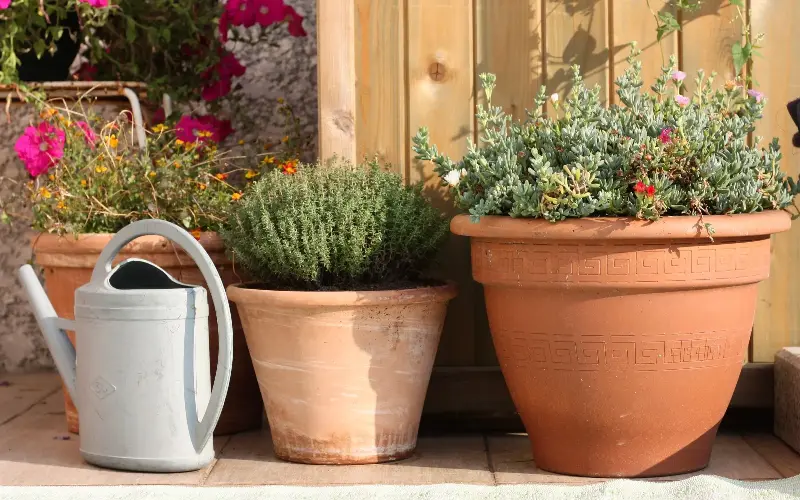
Grouping pots together will help to make watering more time efficient, with the extra humidity caused by dense foliage helping plants through tough times. During spells of particularly hot weather, move pots away from their sun-baked spots to areas in the shade, to help plants survive these difficult times. These periods of intense heat will damage most plants, but once the worst is over, it can be business as usual, and you can return them to their original spot.
Acers (or Japanese maples) in pots are especially vulnerable and should be protected. The damage comes from two fronts: scorched foliage by the sun and drying winds, coupled with high temperatures within the pot, causing root damage. Acers in pots are best placed in a sheltered, shady spot in the garden, and not allowed to dry out during the summer.
Group plants with similar requirements together to help with your watering routine, and to avoid accidentally watering plants that don’t require it; succulents and Mediterranean herbs will require less water than bedding plants, for instance, so group the pots of thirsty plants together.
Top-dressing your containers with bark or gravel that is several centimetres deep, will also slow down evaporation; water well before applying the mulch. For large containers that cannot be moved into the shade, try draping an old net curtain or horticultural fleece over the plant, which will filter the light and reduce evaporation during times of excessive heat.
How to water
When it comes to a watering technique, most of the water is required at the root, not all over the leaves. A watering can is an efficient way to water your plants, as the amount of water that you apply can be easily controlled. Watering with a hosepipe – where it is allowed – can save time, but it is harder to gauge how much water you are applying. You’ll be surprised how much water is given to a plant by just a few seconds from a hosepipe. To understand how much water you are giving your plant through a hosepipe, get a feel for how long you water the plant, and then hold that hosepipe over a bucket for the same amount of time. The amount of water that you are giving your plant will be visible within the bucket. Moreover, most of this water will drain out of the base of the pot and be wasted. Containers can be placed in a saucer, which will act as a reservoir to be utilised by the plants during hot spells.
Automatic systems
Irrigation techniques cover a vast spectrum: from an upside-down plastic drinks bottle with the bottom removed and filled with water as a reservoir, right the way through to soaker hoses on a timer, or a remotely monitored watering system controlled by an app.
The most effective and efficient way to irrigate your plants is through a drip irrigation system, which pumps water through pipework to nozzles that are inserted into a root ball. This delivers water gradually, to meet the plant’s needs with no wastage. Ultimately, there are pros and cons for automated systems, and they suit some people more than others. The level of sophistication that is delivered with these systems is also wide-ranging, as is the budget required to purchase them. I discovered that a solar-powered system that drew water from a recycled bottle from a water dispenser (the ones you find in an office), worked incredibly well and cost less than £50.
Lawns
In all honesty, it’s very hard to maintain grass without copious amounts of water during prolonged periods of hot and dry weather. Tougher grasses will recover in the main, but finer lawns may suffer. Weeds tend to be more resilient than turf, with deeper roots, so they can make your lawn look untidy.
Simply mow the tops off, avoiding damaging the grass by cutting with a higher-set blade. Scarify in the autumn to remove thatch and promote a more robust turf, or consider leaving some areas to grow long. Well-kept lawns are becoming increasingly hard to maintain and justify in such conditions; it’s not what everyone likes to hear, but I’m afraid it’s a harsh reality.
Drought-tolerant plants
If you want to future-proof your garden and reduce watering demands, invest in silver-foliaged plants that are naturally adapted to hot, dry conditions. Their pale foliage reflects sunlight, helping to protect them from intense heat. Many Mediterranean species fall into this category, including stachys, lavender, sage and artemisia.