



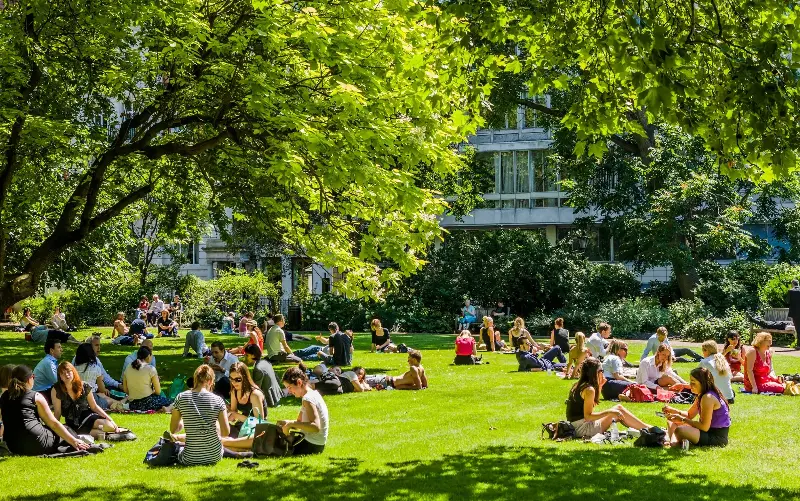
London is defined by its squares. In 1725, Daniel Defoe marvelled at the city’s growth: “New Squares and new streets rising up every Day to such a prodigy of Buildings.” In 1940, John Betjeman painted Victorian expansion in similar tones: “Neat new-built villas, ample Grecian squares.” Even London’s soap opera, EastEnders, revolves around the fictional Albert Square.
London’s squares evolved from Italian piazzas and French places. Their pioneers knew both. Inigo Jones, who helped design Lincoln’s Inn Fields in the 1630s, and Henry Jermyn, promoter of St James’s Square in the 1660s, had both toured Europe.
Yet London turned the continental model into something unique and paradoxical: lush gardens rather than austere paving enclosed by terraced houses rather than palaces. London’s squares are town pretending to be country, and middle-class respectability pretending to be princely.
They are integral to an understanding of the city and its past, and demand a place on any visitor’s itinerary. So, as one of its grandest – the elegant Grosvenor Square – reawakens after a £22m makeover, here are 10 of the best.
Lincoln’s Inn Fields
The history of London’s squares began with Jacobean NIMBYism. In 1613, gentlemen of the Inns of Court, worried that open fields on which they exercised were about to be built upon, petitioned James I that they “might for their generall Commoditie and health be converted into walkes”.
The king agreed. The landowner, William Newton, unable to build on the “walkes”, erected 46 houses around their edge, thus inadvertently creating London’s first garden square. Appropriately, it is called “Fields” to this day. (Leicester Square, with a similar pre-urban genesis, was known as Leicester Fields until as late as 1830.) Come for the “walkes”, stay for London’s most eccentric museum, the Sir John Soane Museum, on the northern terrace.
Nearest tube: Holborn
St James’s Square
London’s most princely garden square was developed by the city’s first aristocratic developer, Henry Jermyn, Earl of St Albans – spymaster, diplomat and bon vivant, father figure to Charles II and possibly lover to Charles I’s widow, Henrietta Maria. Eleven of its buildings retain 17th or 18th-century fabric.
Their stories are as rich as their architecture. In 1815, Major Henry Percy, splattered and bloodstained, brought the victorious news of Waterloo to the Prince Regent, attending a ball at No 15. Percy was promoted to colonel on the spot. Hedge funders and art-gallery assistants eat elegant luncheon sandwiches on the park’s benches: new money enjoying the urban legacy of old money.
Nearest tube: Piccadilly Circus
Grosvenor Square
Almost too spacious and regular to feel English. At the heart of Mayfair’s symmetrical street grid, and appropriately for the former home of the US Embassy, its dimensions seem American. The scale is enhanced by setting the houses 30ft back from the street frontages, so that the square opens up as you enter. London’s first squares were austerely planted.
That changed with Grosvenor Square. In 1725, the gardener, Thomas Fairchild, persuaded Sir Richard Grosvenor to create a verdant “wilderness worke” of trees and bushes, a tradition revived in Grosvenor Square’s recent replanting.
Nearest tube: Bond Street
Cleaver Square
South London’s first garden square, laid out in 1789, is also one of its most charmingly neighbourly. Enthusiasts play with incongruously French pétanque sets. During a late spring afternoon, there is no better place to sample a beer than the Prince of Wales pub in its northern corner.
Nearest tube: Kennington
Fitzroy Square
A brilliant white snowstorm of a square in sheening stucco and gleaming Portland stone. Two sides were designed by one of Britain’s most gifted architects, the sinuously playful Robert Adam. The square was carefully restored after war damage; partly pedestrianised in the 1970s; and its paving elegantly re-laid in 2008. Visiting is joyful and worth a detour. Join the Georgian Group, and you can visit their HQ at No 6 for events and enjoy the square inside and out.
Nearest tube: Warren Street
York Square
Not every London square was built for doctors or dukes. York Square was laid out in 1823 by the Mercers’ Company for the clerks and skilled tradesmen of London’s fast-growing docks. Its low stock-brick terraces, mansard roofs and fanlit doors form a remarkably complete shell of Regency London in a choppy sea of post-war modernism.
The garden became public in 1904, leased to the London County Council for one shilling a year. In 1987 the Queen Mother visited the corner Queen’s Head pub, pulled herself a pint and drank it. The square is said to have helped inspire Albert Square in EastEnders.
Nearest tube: Limehouse
Walcot Square
If you’re visiting the Imperial War Museum, stroll to the delightful Walcot Square, which is actually a triangle. Formerly marshland, then market gardens growing London’s vegetables, Walcot Square was developed in the 1830s by local builders John Woodward and John Chapman. It shows the quality of Victorian lower-middle-class housing. Damaged in the blitz, post-war homes were re-built to match the old, a rarity in 20th-century London. It is a treat trying to identify them.
Nearest tube: Lambeth North
Cadogan Square
Depending on your definition of a square, London has between 300 and 600, most dating from the 19th century. One of the most highly spiced is Cadogan Square: laid out from 1877, a virtuoso display of late-Victorian exuberance.
Six-storey red-brick houses, richly flavoured with terracotta decorations, mingle Queen Anne, Flemish and Gothic details, gables, turrets, oriel windows and exuberant chimneys. Osbert Lancaster later christened the style “Pont Street Dutch”. During the Second World War, the garden was requisitioned and equipped with anti-aircraft guns, while barrage balloons floated overhead.
Nearest tube: Sloane Square
Arnold Circus
London’s garden square became municipal at Arnold Circus, heart of the Boundary Estate, one of the world’s first council estates. Opened in 1900 on the site of the cleared Old Nichol slum, its handsome red-brick mansion blocks radiate from a raised circular garden. The hill was formed from earth excavated for their foundations and crowned by an octagonal bandstand. The result is municipal housing conceived not as a grudging necessity but as civic architecture: varied, dignified and joyful around a shared green heart.
Nearest tube: Shoreditch High Street (overground)
Union Square
Houses on squares are worth more than identical houses around the corner. Developers know this, often mendaciously hoisting “square” nomenclature onto sterile and ugly developments that are not squares at all, but cul-de-sacs scooped out of existing urban blocks.
One exception is Union Square. In 2004, the housing association, Hyde, recklessly promised to listen to residents when regenerating a catastrophically unsuccessful post-war Brutalist estate. Of course, residents asked for their square back. Miraculously, the Victorian square was partly rebuilt with London stock bricks, a proper cornice and rusticated stucco. Visit and marvel.
Nearest tube: Angel
Nicholas Boys Smith is the founder and chairman of Create Streets and visiting professor of architecture at the University of Strathclyde. His history of London’s Monopoly streets, No Free Parking, is published by Bonnier Books.