



The M Shed Museum in Bristol has unveiled a new permanent display of the controversial statue of 17th-century slave trader Edward Colston, which was graffitied, toppled (during an anti-racism protest in June 2020) and thrown into the city’s harbour before being dredged out.
A survey of 14,000 Bristolians found that 80 per cent supported the statue’s new home, as it helps to contextualise its history and place other statues in the UK with links to the slave trade under review.
More than anything else, however, this stands as a reminder of the incredible power of the humble statue – capable of stirring up emotion, awe and, in some cases, complex controversy. Seeing who – or what – a nation has chosen to immortalise in this way can be an illuminating window into its culture, history and psyche. So, what do Britain’s most pivotal statues say about us?
From political flashpoints to beloved local icons, here are 15 of the UK’s most interesting, storied and divisive statues and sculptures, and why they’re worth a visit.
Duke of Wellington
Royal Exchange Square, Glasgow
Standing since 1844 outside what is now the Gallery of Modern Art (GOMA), Carlo Marochetti’s equestrian statue was erected in tribute to Arthur Wellesley (aka the Duke of Wellington, famed for trouncing Napoleon at Waterloo). Glaswegians, however, had other ideas. Since the 1980s, an orange traffic cone has regularly appeared atop the Duke’s head. Whether it’s the work of drunken revellers or civic creativity, no one seems to know. Fines, CCTV, and even plans to raise the plinth have all failed to deter placement of his “top hat”. Instead, the cone has become a much-loved symbol of Glasgow’s irreverent humour.
Paddington Bear
Paddington Station, London
Cast in bronze in 2000 by sculptor Marcus Cornish and found on platform one of Paddington Station, this statue depicts the marmalade-loving bear sitting on his suitcase, complete with his famous “Please look after this bear” label – polished to a high sheen by the hands of adoring fans. It marks the moment Paddington, created by author Michael Bond, first arrives in London from Peru, wide-eyed and slightly bewildered by the bustle around him (a familiar feeling for many a new arrival to the capital).
Angel of the North
Gateshead, Tyne and Wear
With a wingspan wider than a jumbo jet, Antony Gormley’s Angel of the North greets millions of travellers on the A1 every year, and has become one of Britain’s most iconic modern landmarks. This wasn’t always the case: as some will remember, when it was unveiled in 1998, newspapers billed the vast steel figure an “eyesore” and “rusting waste of money”. Today, it’s a beloved symbol of the North East’s pride, resilience and humour, and it’s not uncommon to see motorists waving to the giant as they drive by this now symbolic “gateway” to North England.
The Kelpies
Falkirk, Scotland
These two shimmering, 98ft-high horse heads, rearing from the ground, are the tallest statues in the UK. Erected to celebrate Scotland’s horse-powered industrial heritage, Scottish artist Andy Scott was inspired by the folkloric kelpies – shape-shifting water spirits said to lure people into lochs. Coincidentally, they sit proudly beside a canal lock, as if they might dip their heads for a drink at any moment. They’re at their most mythical when up lit at night.
Nelson’s Column
Trafalgar Square, London
Standing tall in the heart of Trafalgar Square, Nelson’s Column is one of London’s most famous meet-up spots. Built in 1843 to honour Admiral Horatio Nelson’s defeat of Napoleon at the Battle of Trafalgar, the statue tops a 170ft granite column, famously guarded by four bronze lions. It’s history, heroism, and Victorian overachievement in one towering package.
The Beatles
Pier Head, Liverpool
Based on a photograph taken in 1963 – the year the fab four went from being local lads playing tiny venues to global icons – this statue was erected in December 2015 to mark 50 years since The Beatles’ last concert at the Liverpool Empire Theatre.
Find the “Easter eggs” celebrating something personal about each band member: Paul McCartney holds a camera close to his chest in a nod to his late wife, Linda McCartney; George Harrison’s belt bears a Sanskrit inscription symbolising his spiritual interests; the sole of Ringo Starr’s right shoe is inscribed with the postal code “L8”, referencing his childhood Liverpool’s Welsh neighbourhood; and John Lennon carries two acorns in a nod to his and Yoko Ono’s 1968 acorn-planting gesture for world peace.
Greyfriars Bobby
George IV Bridge, Edinburgh
Greyfriars Bobby is one of Scotland’s most heart-melting landmarks. It honours a tiny Skye Terrier said to have guarded his owner John Gray’s grave for 14 years after his death in 1858. The story became famous in Victorian Edinburgh and the statue was erected in 1873 by philanthropist Baroness Burdett-Coutts. Bobby himself was cared for by locals and reportedly fed at a nearby tavern, now named after him. His tiny figure sits just outside the gate, the nose polished to a shine by generations of visitors.
Peter Pan
Kensington Gardens, London
Commissioned by author JM Barrie himself and erected in Kensington Gardens (directly opposite Barrie’s home at 100 Bayswater Road), Peter Pan has delighted many a child in its more than a century-long tenure. It depicts the boy who never grew up standing atop a tree stump, surrounded by squirrels, rabbits and fairies. Barrie secretly arranged to have it installed overnight on April 30, 1912, so that the local children would wake up on May Day believing fairies had placed it there.
Another Place
Crosby Beach, Liverpool
Antony Gormley – best known for creating the Angel of the North – returns to our list with Another Place, a striking installation of 100 cast-iron figures on Crosby Beach, just north of Liverpool. The life-sized sculptures are cast from the artist’s own body and stand spaced along nearly two miles of sand facing out to sea, as if lost in thought or longing for somewhere beyond the horizon. The tides regularly hide and reveal them, so no two visits are ever the same and, over time, barnacles and seaweed have given each figure its own unique, sea-worn personality. Originally temporary, the project proved so popular it became permanent.
Millicent Fawcett
Parliament Square, London
This is a statue of firsts. It was the first statue of a woman in Parliament Square, and the first work there by a female artist. Unveiled in 2018, it was created by artist Gillian Wearing after a campaign led by Caroline Criado Perez, who argued public space should reflect public history – and that women had been systematically left out of it. It honours suffragist leader Millicent Fawcett (1847-1929), who led the National Union of Women’s Suffrage Societies and helped win the vote for women. Notice the banner she holds, which reads: “Courage calls to courage everywhere.”
Verity
Ilfracombe Pier, Devon
People either love or hate Damien Hirst’s Verity. Found on the pier in his hometown of Ilfracombe, this towering sculpture depicts a pregnant woman holding a raised sword in one hand and the scales of justice in the other, standing atop a pile of law books. One side shows a classically idealised figure, while the other is flayed open to reveal muscles, organs and a developing foetus. It’s a bold clash of beauty and brutality, designed to show the contrast between traditional societal values (the law, justice, new life) and the sometimes uncomfortable naked “truth” of reality.
Eric Morecambe
Morecambe Pier, Morecambe
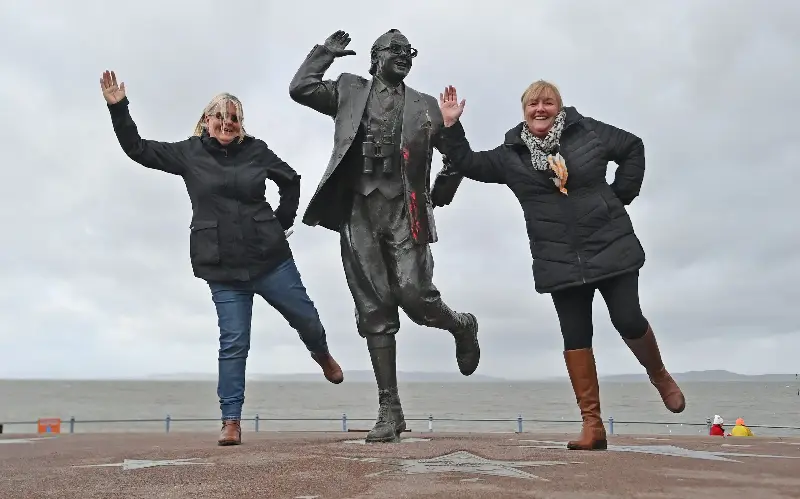
This is a feel-good tribute to a Lancashire legend and one of Britain’s best-loved entertainers. Unveiled by the Queen in 1999 and sculpted by Graham Ibbeson, it celebrates Eric Morecambe (born John Eric Bartholomew), who borrowed his stage name from his hometown and went on to become one half of the legendary Morecambe and Wise double act. The bronze freezes him mid-Bring Me Sunshine pose, arm and leg akimbo, which visitors inevitably copy for photos.
Batman
Leicester Square, London
Leicester Square is dotted with tributes to Hollywood icons, including Harry Potter, Mary Poppins, Mr Bean and Bridget Jones, all of which can be explored on a free Scenes in the Square audio walking tour on Spotify, narrated by Alex Zane. But not all are at street level. One of the most easily missed is Batman, who is perched dramatically beside the Odeon Cinema tower, surveying the West End below as if it were Gotham City itself.
William Shakespeare
Henley Street, Stratford-upon-Avon
There are thought to be more than 100 statues worldwide honouring the man who infused the English language with an estimated 1,700 new words. Unsurprisingly, Stratford-upon-Avon – his birthplace – is home to several of them. The newest was erected on Henley Street in 2020, just a few doors down from his Tudor home and stands 8ft tall – no doubt to remind passersby of his enormous impact on literature. He carries a quill and parchment, and carved into the paving stone at his feet is a quote from The Tempest: “O brave new world that has such creatures in’t!”
The Meeting Place
St Pancras Station, London
Entwined beneath the clock at St Pancras International, The Meeting Place is the first thing Eurostar passengers see when they arrive in London. Created by sculptor Paul Day and unveiled in 2007, the 30ft bronze statue depicts a couple (modelled on Day and his French wife) locked in an embrace, to celebrate the reunions, farewells and long-distance romances associated with travel. Often nicknamed “the lovers”, critics initially dismissed it as overly sentimental, but it has since become one of London’s most-loved modern sculptures.
Have we missed any especially iconic British statues? Let us know in the comments.