



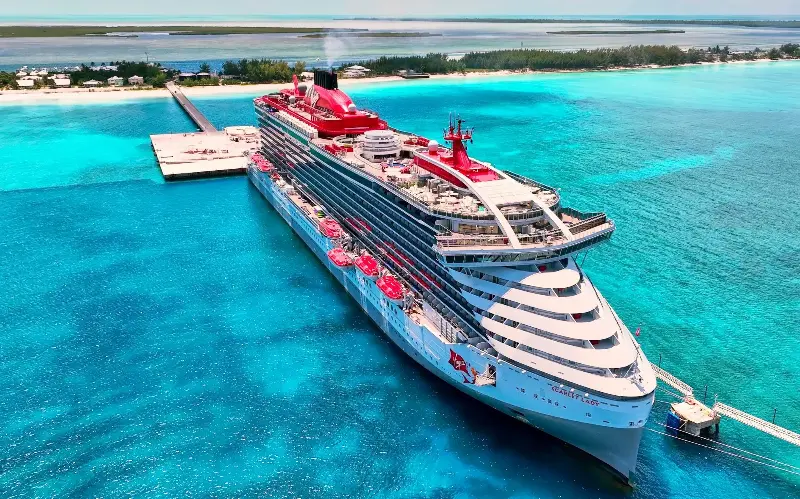
Cruisers looking forward to a bit of sun, sea and sand in Bermuda aboard Virgin Voyages’ Valiant Lady during America’s spring break had an unwelcome shock a couple of days before setting sail from New York City.
Stormy seas, they were told in an email, meant the ship would instead be sailing to St John, a Canadian town offering a dramatically different setting – where daily temperatures in April often dip below freezing.
Cruise lines often have to change itineraries; how it’s done makes a big difference.
A light-hearted email that didn’t apologise but warned that “St John will feel a little bit different from Bermuda” and that “you may want to bring a few extra layers” did not cut it for India McCue and her husband, Ian, whose TikTok video of their shock and disappointment upon reading the email went viral.
Here’s everything you need to know about what happens when a cruise line alters its itineraries.
Why do cruise lines change itineraries/shuffle ships?
It can be for any number of reasons, including riots, strikes, medical emergencies or a technical issue with the ship. Swan Hellenic hit the headlines in 2024 when its expedition ship, Diana, had to skip Antarctica because of a faulty propeller.
War zones are also a no-no for cruise ships. Case in point? Passengers on Oceania Cruises’ 180-day world voyage were due to call into the Middle East and transit the Suez Canal in May but are instead being routed through the Indian Ocean and around Africa. The adults-only line did not respond when asked whether compensation was offered.
Unsurprisingly, the main reason for itinerary changes is the weather, and it could mean the difference between smooth sailing and hours spent peering into the bottom of a sick bag.
In a statement after the McCues’ video went viral, Virgin Voyages said the weather forecast for its planned route to Bermuda “would have presented genuinely unsafe conditions for our sailors and crew”.
Are itinerary changes common?
Happily no. That’s not only good news for passengers but also for the cruise lines, as changes create a massive amount of work.
If they can find an alternative port to visit, they have to make sure there are dockers to tie up the ship and border force staff to work the security desks – while also finding new excursions, and fast.
If it means a day at sea, the staff have to come up with activities and talks to keep passengers entertained.
Contrary to what many cruisers believe, lines will always stick to plan A if possible.
What should I expect if my itinerary is changed?
Companies seek to notify passengers as soon as possible of any changes to itineraries, which may also happen mid-cruise. Unless the cruise line cancels the holiday, however, it does not have to offer compensation.
Royal Caribbean says it “shall not be liable for any loss whatsoever to guests by reason of such cancellation, advancement, postponement, deviation or substitution”.
That message is repeated in the frequently asked questions sections of other lines’ websites or in their ticket contract.
If my cruise itinerary/ship changes, can I get my money back?
Cruise lines are more generous than most other travel companies and often go above and beyond what they have to do to look after passengers, as keeping guests on side is easier than finding new ones.
Virgin Voyages’ ticket contract says the line “may for any reason at any time and without prior notice” choose to “cancel, advance, postpone or deviate from any scheduled sailing, port of call, destination, lodging or activity”.
It adds that if the route changes, it will not be “liable for any claim whatsoever by Guest, including but not limited to any losses, compensation or refund”.
All very clear, but in the case of the Bermuda/St John switch, Virgin did offer compensation. Sailors (as the line calls its passengers) could cancel in return for a future cruise credit to the full value of the booking – which Virgin said it does not “typically provide within 45 days of sailing”. The alternative was to continue with the cruise and receive $100 per cabin Sailor Loot (aka onboard credit).
A future cruise credit wasn’t an option for the McCues, as it was too late for them to cancel flights, and Ian McCue’s parents – who were joining them on the cruise – were already in New York with the couple’s luggage.
Will my insurer refund or compensate me?
That depends on your travel insurance. Several travel insurers offer specific cruise insurance as a bolt-on extra to their standard policies that includes, among other things, cover for missed excursions and itinerary changes. It sounds perfect, but there are a few catches.
Case in point? Virgin Money’s missed port cover won’t pay out if your ship stopped at an alternative port or the line offered financial compensation of any sort – for instance, some onboard credit.
As for missed excursions, Virgin Money will pay out only if the miss was because you were confined to your cabin because of sickness or injury.
Where else can I go for help or advice?
A travel agent may be able to help if you used one, but the best advice is to speak with your cruise line directly.
It’s also worth pursuing a claim with the cruise line. In 2024, Disney Cruise Line told passengers that a cruise from Sydney to Nouméa would replace the South Pacific stop with two alternatives in Australia because of unrest in New Caledonia.
Disney initially refused to compensate passengers who cancelled because of the change, but it eventually backed down and refunded the cost of the cruise.
Expert opinion
I’ve experienced many itinerary changes on the hundreds of cruises I’ve done over the years, and while it’s invariably disappointing I’ve always tried to remind myself that cruise lines don’t skip a port or sail somewhere else for fun.
By all means, take a future cruise credit (if offered or practical) if you really don’t like the look of the new itinerary. Otherwise, why not view it as an adventure – a chance to discover somewhere you’d never have thought to go. Who knows, you might even love it.
About our expert
Jane Archer
Around 25 years ago, Jane never expected to even step on a cruise ship. Now she spends more than 100 days a year at sea or on the rivers, and can’t imagine seeing the world any other way.