



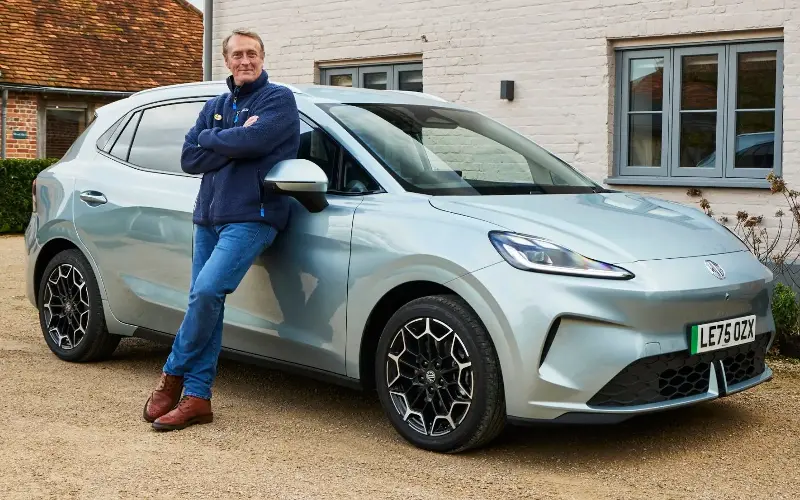
“Am I worried? Should I be worried?” asks David Allison, MG’s long-standing director of product and planning. It’s a rhetorical question, but as MG launches this new front-wheel-drive version of its best-selling MG4 electric vehicle (EV) – the MG4 Urban – the spectre of competition from fellow Chinese firms Chery, Xpeng, Changan, Geely and Leapmotor looms large. Last year Chinese car makers occupied almost a tenth of the UK’s new car market – and it’s growing.
Wait a minute though, MG is also Chinese, the Shanghai Automotive Industry Corporation (SAIC) to be exact, which purchased the revered Morris Garages name from Nanjing in 2007, which had purchased MG from the British-owned MG Rover Group in 2005. MG Motor (as opposed to the original 1930s MG Cars) officially launched in the UK in 2016, but its cars had been assembled in the UK from 2011.
Not without some irony, MG, under SAIC ownership, is once again one of the established brands in the UK, levelling off in the last three years, with about 4.2 per cent market share and 10th in the 2025 manufacturers’ hit parade behind Mercedes but ahead of Skoda, Peugeot, Vauxhall and Volvo.
Also ironic is the fact that MG mostly sells hybrid petrol-electric cars (46 per cent) or PHEV plug-in hybrids (9.3 per cent), with battery EVs occupying only 24 per cent of its 85,155 UK sales in 2025. Some UK politicians could do with a lesson in precisely which type of cars the Chinese sell in this country.
Room for improvement
While it didn’t appear in the UK’s top 10 best-selling EVs last year and it is only MG’s fourth best-selling car (10 per cent of MG’s total UK sales), the all-EV MG4 has been a bellwether for Chinese electric cars in the UK.
Launched here in 2022 and aimed at a market corralled by Tesla’s Model 3, the MG4 drove well although the facia and touchscreen resembled a fire sale at Radio Shack. It has sold more than 49,000 in the UK but the EV pack has now overtaken the sporting, rear-wheel-drive MG.
The response was to produce two MG4s, both with a much improved facia and interior quality. The first is an update of the existing car, with a simplified line-up: £29,995, 188bhp Premium Long Range, with a WLTP range of 280 miles from its 64kWh lithium-iron phosphate (LFP) battery; the £32,995 241bhp Premium Extended Range (338-mile range from a 77kWh lithium-ion NMC battery); and the £33,995 442bhp, 4x4 XPower (251 miles from a 64kWh li-ion NMC battery).
The Urban option
Then there’s this all-new, front-wheel-drive Urban model, a hatchback that is longer and wider than the standard MG4. It has a technically inferior (but cheaper, lighter and space-saving) torsion-beam rear suspension replacing the five-link independent system of the older car.
Unlike the standard MG4, the Urban has a winter range-preserving heat pump as standard, with the cheaper but durable LFP battery chemistry.
As a result it is more spacious, with greater leg and head room in the rear seats and a boot space of at least 577 litres against the 388 litres of the standard MG4. There’s a huge (98-litre) under-boot floor storage space, while folding the rear seatbacks liberates at least 1,362 litres. Passenger space has been a strong MG4 selling point and those seats are comfortable, with plenty of storage space around them.
Two battery sizes are offered: 42.8kWh gross giving a WLTP range of 201 miles and 53.9kWh gross giving a maximum of 258 miles. Fast charging is limited to only 87kW DC (82kW for the lower-power model).
The Urban is up to £6,500 cheaper, too. There are three models: £23,496 Comfort Standard Range (148bhp, 43kWh with a range of 201 miles); £25,495 Comfort long range (158bhp, 54kWh, 258 miles) and £27,995 Premium Long Range (158bhp, 54kWh, 251 miles).
MG is offering a £1,500 grant against the purchase price of these cars for the moment, which reduces the starting price to £21,996. In the highly contested C-segment SUV market, that speaks volumes. Rivals include the Citroën ë-C3, BYD Dolphin, Hyundai Inster and the Renault 4 or 5, all good vehicles.
Better interior
If the Urban starts with a disadvantage on paper due to its twist-beam rear suspension and front-wheel drive configuration, plus points are a weight of only 1,520kg for the big-battery model and the facia from a more expensive car.
And as a result the interior is much improved compared with the standard MG4, with large quarter-light windows adding to that sense of space. Yet while the plastics and imitation-leather trim materials are nice to touch, the interior panel gaps and cut lines of the test car were uneven and wrinkled in places, while the whole interior could do with a bit more colour.
The touchscreen is larger than before and augmented with buttons and dials for the heater controls and, hoorah, a radio volume dial. The screen is still a bit of a pain to delve into, however, and if you do that on the move the driver monitoring system quickly makes its presence known.
On the road
Even in the 158bhp/184lb ft Premium Long Range, performance is modest with a top speed of 99mph and 0-62 in 9.5sec, but the relatively light weight means the permanent-magnet motor gathers speed briskly and maintains speed on motorways. There’s a feeling that the chassis development team knows its stuff. The steering is nicely weighted and responsive, the power delivery is well judged and the car feels nicely engineered.
Apart, that is, from the suspension settings; at times it feels as though there’s a hinge in the middle and that the front and rear wheels are riding over completely different surfaces. Not helping the cause are the cheap Far Eastern tyres, which have poor grip and further exacerbate the crashing ride quality.
MG has shown that it can engineer a decent car and the Urban should be way better to drive.
The Telegraph verdict
Not that the opposition is that much better. Chinese cars might improve eventually, but currently they’re predominantly first-generation in feel and driving performance (the refreshed, rear-drive MG4 excepted, which feels like the finished article).
In mitigation, this new Urban version is about as good as a £22,000 electric vehicle can be at the moment. It is good value, efficient and comfortable on short urban routes, but there are better choices for higher-mileage use.
The facts
On test: MG4 Urban
Body style: five-door family hatchback
On sale: now
How much? from £23,496 to £27,995 as tested (£1,500 launch grant not included)
How fast? 99mph, 0-62mph in 9.5sec
How efficient? 4mpkWh WLTP, 3.6mpkWh as tested
Powertrain: lithium-iron phosphate battery 53.9kWh gross (52.8kWh useable), permanent magnet synchronous motor with step-down gear, front-wheel drive
Range: 251 miles WLTP, 199 miles on test
Charging: 87kW DC
Maximum power/torque: 158bhp/184lb ft
CO2 emissions: zero at tailpipe, 23.6g/km well to wheels
VED: £10, then £195
Warranty: 7 years/80,000 miles, lifetime battery warranty for first owner (8 years/100,000 miles for subsequent owners)
The rivals
Nissan Leaf, from £33,000
With the smaller of the two battery options (52kWh), it has a range of 271 miles and can charge at 150kW DC. Nicely styled with a good ride and handling balance, plus it attracts the full £3,750 government grant.
Citroën ë-C3, from £22,095
A good-value family EV slightly wrong-footed by the smaller boutique Renault 5. The range with the 44.2kWh LFP battery is claimed at 199 miles, but in real life is unlikely to exceed 150.