



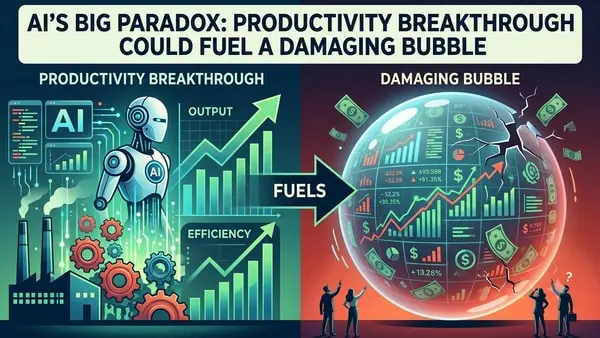
Artificial intelligence could create productivity breakthroughs in history and, at the same time, fuel a damaging investment bubble, according to Ray Dalio, a billionaire investor and the founder of Bridgewater Associates.
Speaking in a video published by the World Economic Forum (WEF), Dalio said the debate over whether AI will transform the economy or pose serious risks overlooks that both outcomes could occur simultaneously.
Dalio argued that transformative technologies typically attract substantial investment because businesses and investors expect them to change the world. That enthusiasm can then lead to overinvestment, rising debt and eventually a bubble-and-bust cycle.
“There’s a process in which great new technologies are something that everybody wants to invest in because they’re going to change the world, and then they over-invest in them, and they create debt, and they go through a certain dynamic, in a sense, that creates a bubble, that creates a bust,” Dalio said in a new video for the World Economic Forum.
“So simultaneously it is going to be one of the biggest productivity-enhancing, changing-the-world forces, and also a bubble that is going to have devastating effects on many people as it works itself through this.”
Taking the dotcom era as an example, he noted that Nasdaq surged 86% in 1999 before falling 77% from its peak by October 2002. Yet the internet itself went on to fundamentally change the economy.
The WEF has separately pointed out that both the productivity potential and distributional risks of AI. Its September 2026 chief economists’ outlook found that 69% expected AI to deliver meaningful productivity gains, while 61% did not expect data-centre investment to generate significant numbers of jobs globally.
Dalio also pointed to a second risk: wealth inequality
“People who come up with great ideas to invent productive things receive capital that enables them to do that,” Dalio continued. “And then as a result of that, that produces very large differences in wealth. A lot of people are benefiting from these miraculous, productivity-en
hancing [technologies].”
Among the top names on Bloomberg’s Billionaires Index, many derive their wealth from tech companies currently investing billions in AI infrastructure and transformation.
Nine out of the top 10 on the list have built their fortune in tech. Leading the pack is Tesla and SpaceX’s Elon Musk, followed by Google co-founder Larry Page and Amazon founder Jeff Bezos.
“But, most people are not benefiting adequately from that,” added Dalio
“So the real question isn’t so much about AI as it is human nature. It’ll have enormous implications for differences in wealth and opportunity. How are those going to be dealt with? These are the big questions of our time.”
Some AI leaders are signalling they want to share the profits: Nvidia founder Jensen Huang, for example, has said he’s open to tax ideas as a “great way for us to contribute back to society and the economy.”