


Curiosity about what lies beyond our blue sky has led humanity on a never-ending quest to explore the cosmos. Every leap in technology opens new vistas, and every discovery seems to deepen the mystery. The universe is filled with puzzles, extremes, and wonders that challenge everything we know about reality. Here are some fascinating facts about space that prove our universe is anything but ordinary.
THE UNIVERSE IS ACTUALLY INVISIBLE
While the night sky dazzles with stars and galaxies, what we see is only a tiny fraction of what exists. In fact, about 85% of the universe is made up of something called dark matter, a mysterious substance that doesn’t emit, absorb, or reflect light. Scientists can't observe it directly, but they know it’s there because of its gravitational effects on visible objects.
Even more mind-boggling, approximately 70% of the universe is driven by dark energy, a force responsible for the accelerated expansion of the cosmos. Combined, this means:
- Everything familiar—stars, planets, and people—makes up less than 5% of the universe.
- The vast majority of our reality remains completely hidden from view.
SPACE IS ANYTHING BUT EMPTY
A common misconception is that space is a complete vacuum where nothing exists—but that’s not quite true. The vast stretches between stars and galaxies are filled with:
- Cosmic dust and stray atoms.
- Energetic rays zooming through at nearly the speed of light.
- Neutrinos: Even a single cubic meter of deep space contains about a million of these particles that pass straight through us without stopping.
A COSMIC TIME MACHINE OVER OUR HEADS
When you look up at the stars, you’re gazing deep into the past. Because light travels at a fixed speed—about 300,000 kilometers per second—it can take millions or even billions of years to reach us from distant galaxies.
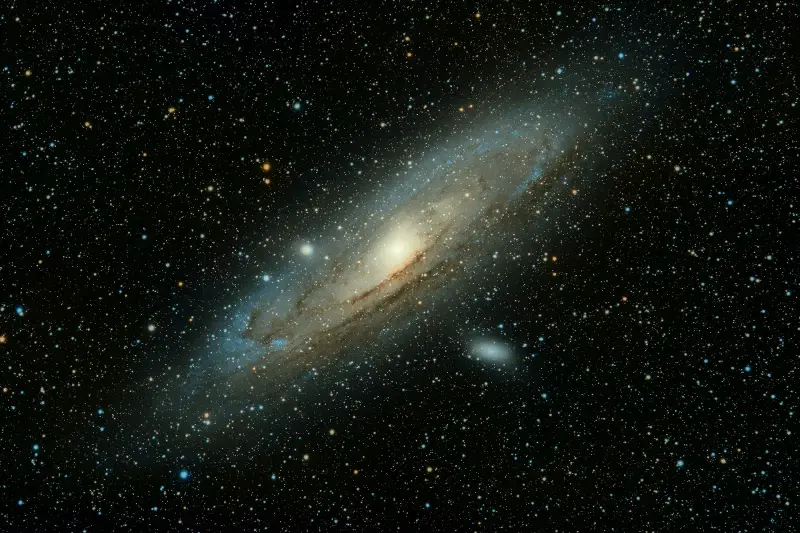
For example, the light from our nearest large neighbor, Andromeda, takes 2.5 million years to reach Earth. When you see it in the sky, you are not seeing it as it looks today, but as it appeared when our earliest ancestors were first walking the planet.
PLANETS: MORE THAN YOU IMAGINED
Our own solar system has eight planets, but astronomers now suspect there might be trillions across the universe. Beyond our cosmic neighborhood, we’ve discovered thousands of exoplanets with unique characteristics:
- Hot Jupiters: Giant, scorching worlds orbiting extremely close to their stars.
- Rogue Planets: Drifting alone through space without any star to orbit.
- Ancient Worlds: The planet PSR B1620-26 b is about 13 billion years old, making it significantly more ancient than Earth itself.
STARS HAVE SOME SURPRISING SECRETS
Stars might look serene, but they exhibit incredibly bizarre behavior. Consider the "zombie star" (SN 2012Z), which survived a violent supernova explosion and continued shining. Even more intense are neutron stars; they are so dense that a single teaspoonful would weigh about six billion tons on Earth. Furthermore, some magnetic white dwarfs have fields millions of times stronger than anything we can create, powerful enough to distort the very shape of atoms.
BIZARRE WORLDS AWAIT
Some planets and moons sound straight from science fiction. The diversity of our celestial neighbors is staggering:
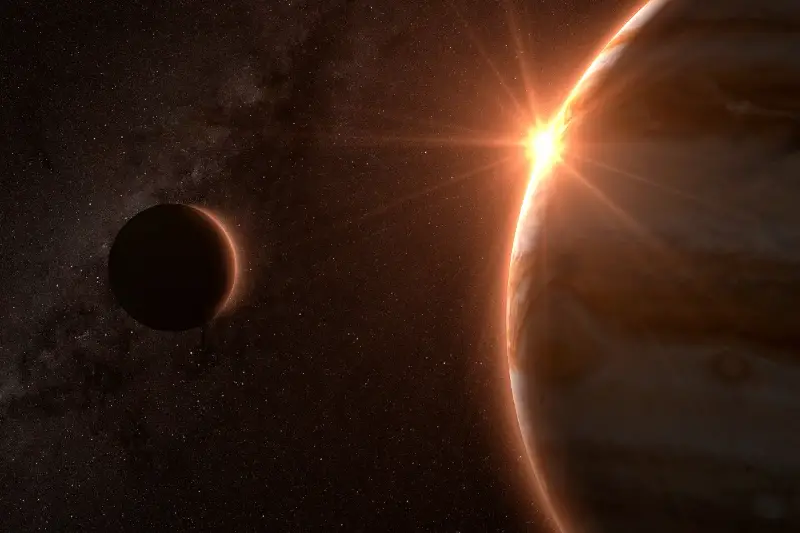
- Io (Jupiter's Moon): The most volcanically active body in the solar system, erupting rivers of molten sulfur.
- Titan (Saturn's Moon): Features lakes and rivers of liquid methane instead of water.
- HD 189733b: A planet 64 light years away where it is believed to rain glass sideways due to winds blowing at 8,700 kilometers per hour.
GRAVITY’S WILD EFFECTS
Gravity works in unexpected ways. Black holes are regions where gravity is so powerful that even light cannot escape. Yet, they aren't just cosmic vacuum cleaners; some spin at nearly the speed of light, twisting space and time itself. Interestingly, astronauts on the International Space Station experience microgravity. They feel weightless not because gravity is gone, but because they are in a constant state of free-fall while orbiting the planet.
SPACE IS CLOSER THAN YOU THINK
Outer space officially begins only 100 kilometers above the Earth's surface at the Kármán line. To put that in perspective: if you could drive a car straight up at highway speeds, it would take less than two hours to reach space.
Every new discovery inspires us to keep asking questions and imagining what else might be out there. The universe remains full of surprises, waiting for the next curious mind to uncover them.