



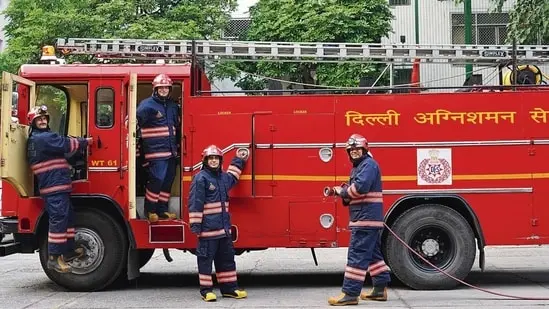
Rampant encroachments, unregulated parking, and congested neighbourhoods are increasingly hindering fire response across Delhi. A ground assessment by Hindustan Times revealed that, in several localities, barely half the road width remains usable — far below what fire tenders require to operate effectively. The additional difficulties in accessing incident sites delay timely rescue and can increase the chances of fatalities and critical injuries.
The ground assessment was carried out using a laser measurement device across eight locations across west, south and east Delhi. Several fires have been reported at or near these areas in the last few years.
The survey found that, while the original carriageway widths in many areas range between 4 and 10 metres, encroachment leaves barely 1.5 to 3.5m of that space accessible. This is far below the 6-7m required for fire tenders to operate effectively.
Also read: The Maharani Bagh in Delhi house that still feels like it was built yesterday
Fire department officials said a standard fire tender is about 2.5m wide and 7-9m long. It also requires a turning radius and manoeuvring space of 4-5m. Additionally, hydraulic aerial platforms, used for high-rise firefighting, need even more room, in addition to a vertical clearance of 4-4.5m.
In the March 18 fire at a four-storey residence in Delhi’s Palam Colony, fire tenders struggled to reach the scene with parked cars occupying a major portion of the approach road, fire officials said. The skylift platform, which was crucial to the rescue operation, allegedly could not operate due to the space crunch and overhead wires. Nine family members, including three children, died in the blaze, with several suffocating on the upper floors as they waited for rescue.
“While reaching the spot was very difficult because of parked vehicles on the approach road, it was very difficult to install the Skylift for the rescue operation due to overhead wires,” said a fire official.
The Public Works Department and the Municipal Corporation of Delhi, who manage these roads, did not respond to HT’s requests for comment.
Also read: Delhi govt set to roll out women’s ₹2,500 monthly aid scheme portal on June 1
Palam Colony
The measure exercise carried out by HT on April 16 found the road outside the affected building to be 7.4m wide. However, just 2.93m was accessible with the rest occupied by parked vehicles and temporary vendors.
Rajesh Sharma, who lives a few metres from the site, said, “When the fire engines come in our area, they have to stop at a distance. Hoses have to be stretched through the lane. Every minute matters in such situations.”
Mohit Kumar, 27, one of the neighbors of the family affected in the March fire, blamed the delay in firefighting operation which added to the tragedy. “All of them would have been saved if the Skylift would have come sooner and started working sooner as well,” he said.
The main approach road near the flyover is 10.23m. But, again, with vehicles parked along both sides, only 3.60m is open.
“People park along both sides because there is no enforcement. The road looks wide on paper but is useless in reality,” said a shop owner, asking not be named.
Rajouri Garden
In a residential neighbourhood near Rajouri Garden Market, west Delhi, the road was measured to be approximately 7.8m. However, with cars parked on both sides, more than half of it — 4.8 metres — was inaccessible.
Parked cars prove the worst nuisance, particularly at night, said officials, since their removal requires figuring out which house they belong to and then asking the owners to move them.
42-year-old Kailash Bhardwaj, who has lived here for decades, said, “Even small cars struggle to pass each other here. If a fire breaks out, I don’t think a fire tender can enter at all.”
The situation is equally concerning in the market — of a total road width of about 6.3, encroachments stretch to cover between 3.3 and 2.8m.
“There is no dedicated parking. People park wherever they find space,” said Ajay Kumar, who works at an apparel shop.
East Vinod Nagar and Laxmi Nagar
In East Vinod Nagar, a residential colony road measured approximately 4.60m in width. After accounting for parked vehicles, only 3.35 metres remained for movement.
In a nearby lane in Laxmi Nagar, the situation is even more dire. The road, measuring 3.66m wide, is already too narrow for a fire tender. Adding to that, encroachments, including two-wheelers, push carts, and staircases built over public land, have reduced the usable width to 1.83m.
“Forget fire tenders, even ambulances cannot enter properly,” said resident Ashish Sinha. “We have raised this issue multiple times with local councilors and politicians who visit the area, but nothing changes.”
Greater Kailash & CR Park
With popular markets in N-Block, M-Block and C-Block, the relatively upscale residential neighbourhood of Greater Kailash (GK) is no stranger to commuter traffic. Despite being a planned colony, in its S-Block, which lies somewhere in the middle, only 3.37m of its 4.1m-wide road, which can extend to 8.9m if footpaths are included, is accessible.
“People assume planned colonies are better, but parking chaos is the same everywhere. In an emergency, we are just as vulnerable,” Malika Sood, a resident, told HT.
Similarly, around 15 minutes away, in Chittaranjan Park’s Block-D, a gated colony, the total road width of 4.98m is reduced to 2.73m just by the way cars are parked.
“Even garbage trucks struggle to enter sometimes. Fire tenders would find it nearly impossible,” said 31-year-old resident, Paulomi Ghosh.
Policy vs reality
While Delhi’s 2019 parking policy mandates that a free lane be left for emergency vehicles, there is low compliance and even lower enforcement.
Part of the problem is a surge in vehicle ownership. “The city was not designed for the current volume of vehicles. Without strict parking regulation and removal of encroachments, emergency response will continue to suffer,” said a senior fire official.
With much of the 33,000km of roads in the city measuring under 6 metres wide, fire officials said structural limitations and lack of off-street parking compound the problem.
Former Delhi Fire Services (DFS) chief Atul Garg acknowledged the issue played a major role in delayed fire response.
“The first four to five minutes are very crucial in any fire incident in terms of controlling it and preventing its rapid spread. But due to encroached roads, fire tenders struggle to reach fire spots timely,” he said.
In such a scenario, which is more often than not, firefighters then park the fire tender at the closest spot to the fire and use the length of the hose pipe to reach the site.