


India, June 22 -- In my 40 years of professional journey, I have seen the remarkable growth in the hospital sector and paradigm shift in the last five decades, starting from doctor-led nursing homes to charitable hospitals to professionally managed and now in the present context, investor-backed, technology-heavy, and multi-location healthcare enterprises.
This is indeed a remarkable journey by all means. Consumerism in healthcare has increased, thanks to Google for generating awareness, and now AI tools like Cloude, ChatGPT and Gemini and others are educating them a lot, and this journey is not to end here, as Indian being a big and attractive market, we have a lot of FII/FPI participation in major visible hospital chains like Apollo, Max Healthcare, Narayana, Aster DM.
In shaping the hospital industry, Private Equity funding has played a pivotal role. In the growth of the hospital industry, the role and support of the Pharma Industry also cannot be undermined, be it Clinical practice and treatment protocols or clinical trials, knowledge diffusion or Hospital pharmacy.
The ratio 1:811that makes us feel good about the problem actually, we haven't solved:
Thanks to our Medical universities ( Govt. and Private both), our Doctor to population ratio has improved: 1:811 (at the aggregate level), but this statistic does not convey anything about the geographical dispersion and concentration, registration vs practice gap and then the distribution by speciality-wise.
A district in Bihar or rural Rajasthan could have ratios many multiples worse than 1:811, while the Metros like Delhi/Mumbai might be pulling back the average up. These statistics do not throw any light in context to the operational unpreparedness esp. in the context of a high-tech health system, it does not convey anything about nurses, allied health workers, technicians, or workers, and it conveys nothing about whether those Doctors have the digital, managerial or systems skills! Thus, this ratio 1:811 (a misleading number) conveys to us "how many", but it does not convey anything about whether they are "equipped" for the system being built.
Hence, in my opinion, even if every gap in that ratio is filled, it will be solving our yesterday's problem and not today's problem, as the workforce India needs today is not just larger but the one that is ready to keep learning even after the degree is over.
Your degree has an expiry date -and most Clinicians don't know it has already passed
In today's content, one must be continuously in the process of Learne Unlearne Relearn. I have rarely seen any "learning ecology" in the organisations which can equip /support the healthcare workers in their productivity or career progression. What I tell a classroom is true - but what happens when an entire institution never relearns is no longer a classroom problem. It is certainly the board-level problem that they inherit without ever being told.
Organisations promote their best clinicians and then abandon them there
During my interactions with the various CEO's/board members, I often ask," What is the criteria for promotion is your business organisation? Is it tenure or clinical expertise? Across all the levels, I call this systemic leadership capability a "Board level risk", as here in this transition, particularly, the leadership capability is assumed; it is not developed. The strategic decisions are driven by clinical or technical bias, which is further compounded by weak financial and people decisions esp. at the senior level. Thus, this lack of leadership quality directly impacts governance, compliance and outcomes.
Thus, the ritual announcement of the promotion is there, but actually, no transition exists; they are still doing the same job with the added responsibility of a new one, whereas the Management Board yardstick still remains the same; it never changes. The organisational systems have everything to measure, but I fail to understand why they cannot measure this visible systemic gap. This failure has only one exit- and it's silent. I have seen management agonise over who to promote into the Management.
Task-Shifting: A Strategic Enabler
The same institution cannot ask/fail to ask the right question- right now, who is there on the floor doing more than their designation and can still be asked safely to do more? So, this risk compounds further when the board member looks only for the upward solutions -i.e. hiring better leaders, building competent pipelines, while at the same time, there is a second, larger source of capability just one level down, already trained, competent, willing, but largely untapped.
This is probably the systemic failure. To overcome this, a better and safer option is "task shifting" in place of "shortage management", irrespective of the fact that whether a hospital has adequate staffing, having a specialist to do that work that a trained nurse or qualified technician can perform equally well, is certainly a misallocation of the most expensive resource in that organisation.
This is proved in various scientific studies, too, such as the landmark IMAPCT Diabetes study. Punjab's I-TREC model further augments and adds credibility to the task-shifting concept. If task-shifting is carried out in a programmed manner with shared decision making, clear process outcomes, adequate training and competency building, it becomes a strategic enabler. Without these, it becomes a liability.
Rural Posting: Career Death Sentence or Opportunity?
In a low-resource setting like India, this task -shifting as a redesign has emerged as a potential strategic enabler, but unfortunately, its value is not evenly distributed, as the problem in rural India starts even one step earlier -retention, as the rural posting is considered a Career Death Sentence. For the last three decades, unfortunately, organisations/governments have mismanaged the rural placements as they have failed to provide proper infrastructure, incentives and desired support, thus making workers feel neglected, isolated, punished and forgotten. In today's context, the current generation views rural posting as a punishment and not as an opportunity.
The career ladder path has not been designed to pass through rural India. The saddest part in this context is that rural postings are considered a transaction and not a relationship.
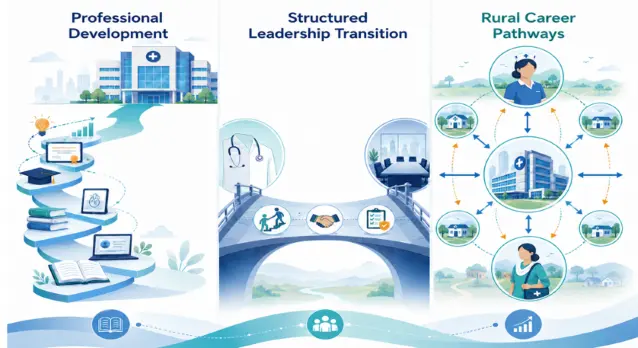
Three Transformative Decisions: A forward-looking actionable framework
Every problem shared above has a common root cause - capability (pl read this as capacity +ability) -and that too at every level -from the board room to the village clinic. The question here is not whether it can be "fixed", but what "fixing" it actually requires. My forty years of professional experience have helped me to see these gaps from both ends - navigating them as a pharmaceutical professional and later in my academic tenure, teaching the students how to navigate. So, what follows is not theory; rather, this is what I believe needs to change, starting with the three decisions any healthcare institution can make today:
And this is precisely the model we are testing as an organisation at HMX (Centre of Health Management Excellence).
Dr Sandeep Narula -Professor and Centre Head, Centre of Health Management Excellence, HMX, Mahatma Gandhi University of Medical Sciences and Technology, Jaipur