


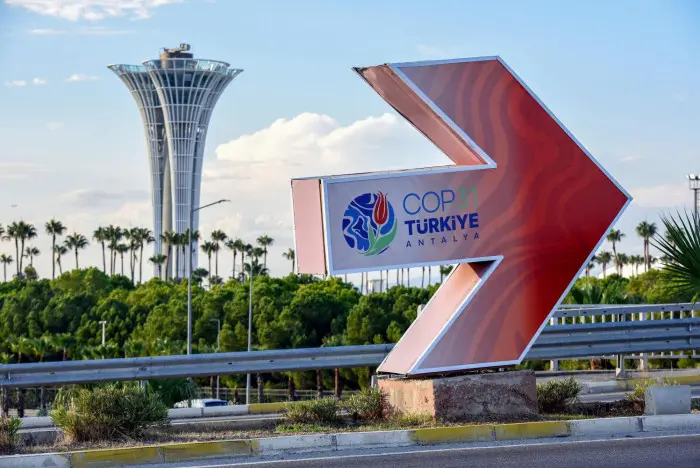
As world leaders gather in Antalya, Turkey, for the United Nations Climate Change Conference (COP31) from Monday to Nov 20, climate adaptation is high on the agenda. The economic case for action is compelling. Measures ranging from flood defences to cooling and irrigation technologies can prevent losses -- including property damage, lower productivity and reduced agricultural yields -- worth many times their cost. Yet the world invests only a fraction of what is needed, leaving many people and assets inadequately protected from extreme weather.
The McKinsey Global Institute (MGI) found that the world spends approximately US$190 billion (6.56 trillion baht) annually on 20 proven adaptation measures that protect against heat, wildfire, flooding and drought. But this is just one-third of the $540 billion needed to protect everyone exposed to climate hazards at developed-economy standards. These measures could cost $1.2 trillion per year when the world reaches 2°C above pre-industrial levels, which current emissions trajectories suggest may occur by around 2050. But we estimate that the returns in avoided losses would be roughly three times the costs of these measures today, increasing to seven times the costs at 2°C of warming.
Clearly, economic benefits are not enough to guarantee investment. The problem is that what makes economic sense for society does not always make financial sense for the households, companies and governments expected to act. Consider the construction of a sea dyke. It protects residents, businesses, property owners and insurers from flood losses, but the public agency building it has no way to recover its costs, because a sea dyke does not produce revenue. Similarly, a bank may struggle to finance an asset with no predictable cash flow.
New research from MGI examining investment barriers across 20 measures finds two preconditions for climate adaptation: households, companies and governments must be willing and able to implement measures, and capital providers must be willing to finance them on acceptable terms. Competing spending priorities, unclear benefits, misaligned incentives and implementation challenges can constrain demand, while repayment risks, uncertain project performance and the difficulty of making numerous small investments can impede financing even where demand exists.
While these barriers often reinforce one another, they are not universal. By 2050, we estimate that measures representing roughly $460 billion in annual adaptation costs -- about 40% of the total needed -- could be "deployment ready", facing minimal demand or financing constraints. Beyond protecting lives and livelihoods, these measures, which range from cooling systems to stormwater management, represent a potential market opportunity for adaptation providers and financiers, and over two-thirds of this opportunity is expected to be in higher-income regions.
But substantial obstacles stand in the way of unlocking the remaining $690 billion in annual adaptation costs required at 2°C, particularly in the least protected places. In India and sub-Saharan Africa, adaptation costs could reach 2-3% of GDP, compared with 0.3-0.5% in higher-income regions. At the same time, less than 20% of adaptation investment needed in these regions is expected to be deployment ready, compared with more than half in higher-income regions, implying a need for innovation in how adaptation is delivered and financed.
Three issues need to be addressed. First, adaptation must become more affordable for households struggling to make ends meet, as about $440 billion in annual adaptation needs could be blocked by competing spending priorities and a lack of creditworthiness. That means cheaper technologies and financing. For example, the municipal authorities in Ahmedabad, India, worked with the Mahila Housing Trust to reduce the cost of heat-reflecting roofs for low-income households through subsidies, credit schemes and coordinated implementation.
Second, stronger incentives, clearer evidence of benefits and improved capabilities could unlock about $210 billion in annual adaptation costs. To create more space for rivers to flood safely, the Netherlands' Room for the River programme had to convince some landowners to relinquish their property or change how their land was used, even as the benefits of the programme accrued broadly across communities. The programme implemented more than 30 projects by aligning incentives through compensation, property purchases and relocation support, and by coordinating between national and local governments, water authorities and communities.
Finally, demand exists for the remaining $40 billion in required adaptation measures blocked by barriers, but these projects must be made bankable through innovative revenue mechanisms and financing structures, or with evidence of reliable performance to reduce investor risk. The Drought Tolerant Maize for Africa initiative demonstrates how early-stage funding can help establish emerging adaptation solutions. Donors supported years of research and field testing, while partnerships with local seed companies helped scale production and distribution. By 2014, drought-tolerant seeds had reached an estimated 5.4 million households.
There are many proven ways to protect people and assets from extreme weather. But advancing adaptation will require each stakeholder to play its part. Companies should integrate climate resilience into investment decisions and develop more affordable adaptation measures. Financial institutions should create financing structures that better capture the economic value of avoided losses. And governments should strengthen incentives, coordinate implementation and direct scarce public resources towards investments that markets alone cannot deliver.
Adaptation has been shown time and again to deliver substantial economic value. The challenge now is to ensure that those who need to invest have the means -- and the incentives -- to do so. ©2026 Project Syndicate
Mekala Krishnan is a partner at the McKinsey Global Institute. Sylvain Johansson is a director at the McKinsey Global Institute. Kanmani Chockalingam is a senior fellow at the McKinsey Global Institute.